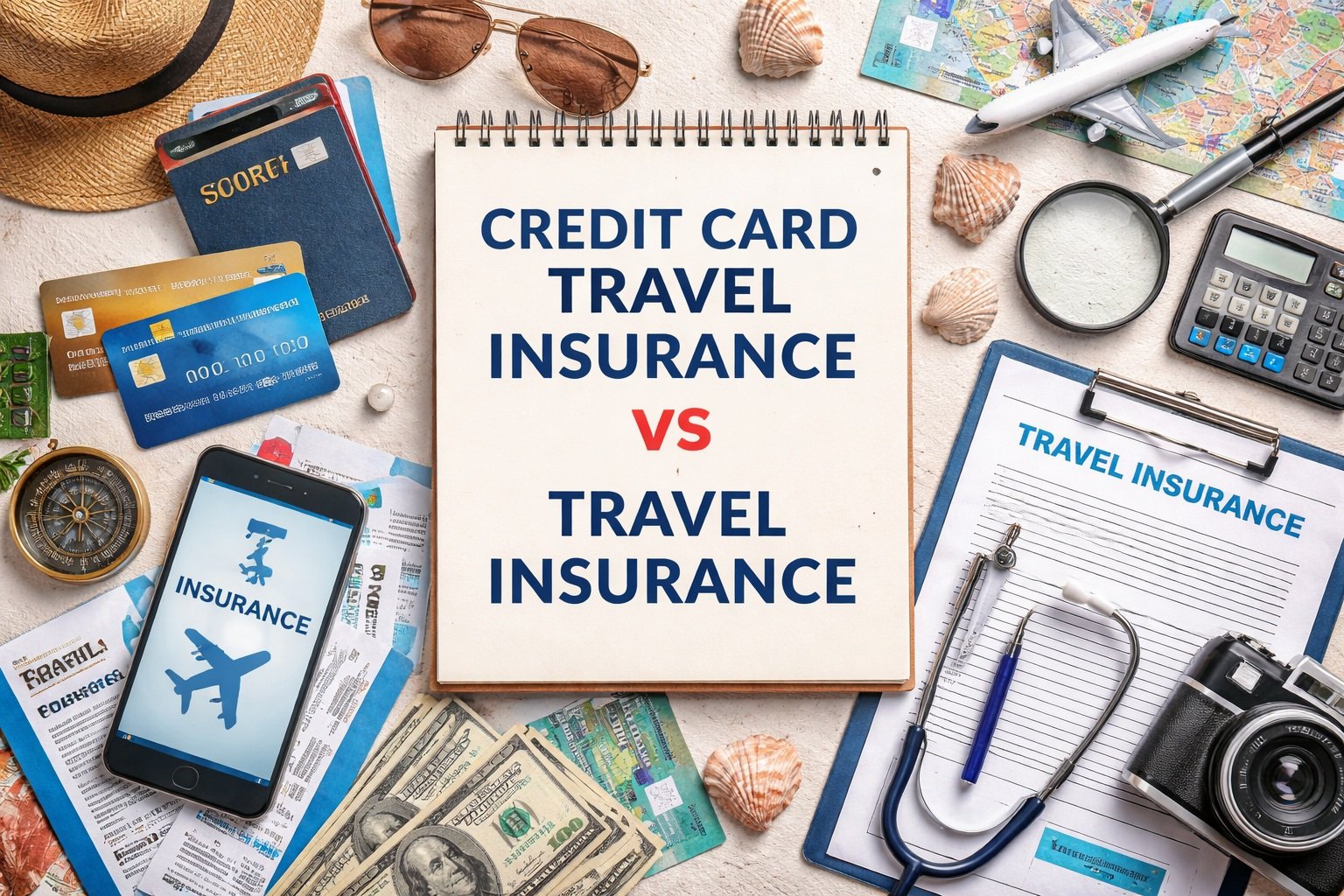
Travel Insurance vs Credit Card Travel Insurance: What’s the Difference?
The difference between travel insurance and credit card travel insurance comes down to coverage, flexibility, and reliability. Credit cards may include basic protections such as trip delays or baggage coverage, but they rarely provide comprehensive medical coverage or full trip protection.
Many travelers assume their credit card offers enough protection because it includes “travel benefits.” In reality, these benefits are often limited, require specific conditions (such as paying for the trip with the card), and may not cover the situations that matter most, especially medical emergencies abroad.
Dedicated travel insurance is designed specifically for travel risks. It typically includes medical coverage, trip cancellation protection, and emergency assistance, making it a more complete solution for international travel or longer trips.
In this guide, we compare how credit card travel insurance works, what standalone travel insurance covers, and when each option is enough. By the end, you’ll be able to decide whether your credit card protection is sufficient or if you need a full travel insurance policy.

What Is Credit Card Travel Insurance?
- Included with: premium credit cards
- Activation: pay for travel with the card
- Typical coverage: delays, cancellations, lost baggage
- Main limitation: limited medical coverage
Credit card travel insurance is a set of travel protections included with certain credit cards. It is not a standalone policy, but a benefit that activates when you pay for your trip using the eligible card.
Most credit cards offer coverage for situations such as trip delays, cancellations, interruptions, and baggage issues. These protections can be useful for short trips or minor disruptions, especially when everything is booked using the same card.
However, the coverage is usually limited. Benefit caps are lower, exclusions are more common, and many credit cards do not include comprehensive emergency medical coverage for international travel.
Because of this, credit card travel insurance works best as a basic safety net rather than full protection. Always review your card’s specific terms before relying on it for your trip.

What Is Travel Insurance?
- Type: standalone travel policy
- Main coverage: medical emergencies, cancellations, delays
- Best for: international travel and longer trips
- Key advantage: comprehensive medical protection
Travel insurance is a standalone policy designed to protect you from unexpected problems before or during a trip. Unlike credit card travel coverage, it is built specifically for travel risks and typically offers broader and more reliable protection.
The most important feature is emergency medical coverage. If you get sick or injured abroad, travel insurance can cover hospital costs, treatment, and emergency evacuation, which are often not included in credit card protections.
Most policies also include trip cancellation, trip interruption, travel delays, and baggage protection. This means you are covered not only during your trip, but also before departure if your plans change unexpectedly.
Because travel insurance is purchased separately, you can choose a policy that matches your trip. Coverage can be adjusted based on destination, duration, and the level of protection you want.
For a full breakdown of how coverage works, see our complete travel insurance guide or compare options in this travel medical insurance comparison.

Travel Insurance vs Credit Card Travel Insurance: Key Differences
- Coverage scope: travel insurance is comprehensive, credit card coverage is limited
- Medical coverage: included in travel insurance, often missing or minimal with credit cards
- Flexibility: travel insurance can be customized, credit card coverage cannot
- Activation: credit card requires payment with the card, travel insurance does not
- Best use: travel insurance for full protection, credit card as backup
The main difference between travel insurance and credit card travel insurance is the level of protection. Travel insurance is designed to cover major risks such as medical emergencies, cancellations, and disruptions, while credit card coverage is typically limited to specific travel inconveniences.
Credit card travel insurance usually focuses on delays, baggage issues, and partial trip cancellation coverage. These benefits can be useful, but they often come with strict conditions. In most cases, you must pay for your trip with the card, and coverage limits are lower.
Travel insurance offers broader protection. It typically includes emergency medical coverage, hospital treatment, and evacuation, which are critical when traveling internationally. This is the biggest gap between the two options.
Another key difference is flexibility. Travel insurance allows you to choose coverage levels based on your destination and trip length, while credit card benefits are fixed and cannot be adjusted.
In simple terms: credit card travel insurance works as a basic safety net, while travel insurance is designed to fully protect your trip.
For most international travel, using both can make sense — but relying only on credit card coverage often leaves important gaps, especially for medical emergencies.

Medical Coverage
- Travel insurance: full medical coverage included
- Credit cards: limited or no medical protection
- Biggest risk: hospital bills and evacuation costs
- Best choice: travel insurance for international trips
Medical coverage is the most important difference between travel insurance and credit card travel insurance. Most credit cards focus on trip disruptions, while medical protection is often minimal or not included at all.
This creates a major risk for international travel. Hospital treatment, emergency care, or medical evacuation can cost thousands — and in some countries, treatment may require proof of insurance before you are even admitted.
Travel insurance is designed to cover these situations. Policies typically include hospital treatment, doctor visits, emergency care, and evacuation if needed, making them essential for trips outside your home country.
Because of this gap, many travelers use dedicated travel medical insurance even if they already have credit card coverage.
A common option is SafetyWing Nomad Insurance, which is built specifically for international travelers and digital nomads who need flexible medical coverage across multiple countries.
If you want a detailed breakdown of how it works, read this SafetyWing insurance review.

Trip Cancellation and Interruption
- Credit cards: basic cancellation and interruption coverage
- Travel insurance: higher limits and broader protection
- Main condition: credit cards often require full payment with the card
- Biggest risk: losing non-refundable trip costs
Trip cancellation and interruption coverage is one area where credit card travel insurance can provide useful benefits. Many premium cards offer reimbursement for non-refundable expenses if your trip is canceled or cut short due to specific covered reasons such as illness or severe weather.
However, this coverage comes with limitations. In most cases, you must pay for your trip with the credit card, and reimbursement limits are often lower than standalone policies. Coverage may also exclude certain costs or only apply to specific parts of your trip.
Travel insurance offers broader protection. You can usually insure the full value of your trip, including flights, hotels, and prepaid activities, with higher reimbursement limits and more flexible coverage options.
This difference becomes important for expensive trips. If you are booking multiple destinations, long stays, or non-refundable experiences, relying only on credit card coverage can leave gaps.
In simple terms: credit cards can cover smaller losses, but travel insurance is better for protecting the full cost of your trip.

Baggage Protection
- Credit cards: basic delay and lost luggage coverage
- Travel insurance: broader protection and higher limits
- Main limitation: low reimbursement caps and exclusions
- Biggest risk: losing valuable items or multiple bags
Baggage protection is one area where credit card travel insurance can be useful for smaller issues. Many cards include reimbursement for essentials like clothing or toiletries if your luggage is delayed for a certain number of hours.
However, these benefits are usually limited. Reimbursement caps are often low, and high-value items such as electronics, jewelry, or specialized gear may be excluded from coverage.
Travel insurance provides more complete baggage protection. Policies typically cover lost, stolen, or damaged luggage, as well as delays, with higher limits and clearer coverage conditions.
This becomes important if you are traveling with multiple bags or carrying expensive items. In those cases, relying only on credit card coverage can leave gaps.
In simple terms: credit cards can help with minor delays, but travel insurance is better for protecting valuable or fully packed luggage.

Coverage Limits
- Credit cards: lower reimbursement limits
- Travel insurance: higher and adjustable coverage
- Main limitation: capped payouts on major expenses
- Biggest risk: large financial loss not fully covered
Coverage limits are one of the biggest differences between travel insurance and credit card travel insurance. Credit cards may offer useful protections, but the maximum reimbursement amounts are often limited.
For example, trip cancellation coverage may be capped at a fixed amount, and baggage or delay benefits often come with relatively low limits. In many cases, these limits are not enough to fully cover the cost of a trip or significant disruptions.
Travel insurance allows you to choose your coverage level. You can insure the full value of your trip, increase medical limits, and select policies that match your destination and travel style.
This flexibility becomes critical for expensive trips. Flights, hotels, and activities can add up quickly, and low coverage limits can leave a large portion of those costs unprotected.
In simple terms: credit cards cap your protection, while travel insurance lets you match coverage to the real cost of your trip.

When Credit Card Insurance Is Enough
- Trip type: short and low-cost
- Destination: domestic or low-risk countries
- Main coverage needed: delays and minor disruptions
- No major risk: limited prepaid costs or expensive gear
Credit card travel insurance can be enough for simple trips where the financial risk is low. If you are taking a short domestic trip, booking with a premium credit card, and not relying on high-cost prepaid bookings, the included protections may cover the most common issues.
These benefits typically include trip delay coverage, baggage delay reimbursement, and limited trip cancellation protection. For minor disruptions, this can be sufficient.
However, this only works if the trip meets the card’s conditions. In most cases, you must pay for the travel using the card, and coverage limits remain relatively low.
Credit card insurance is usually enough if:
- Your trip is short and low-cost
- You are not traveling internationally
- You do not need medical coverage abroad
- You can afford to absorb some financial loss
In simple terms: credit card insurance works for low-risk trips, but it is not designed to fully protect more complex or expensive travel.

When Travel Insurance Is the Better Choice
- Trip type: international or multi-country travel
- Biggest need: medical coverage abroad
- High risk: expensive or non-refundable trips
- Longer stays: extended travel or digital nomad trips
Travel insurance becomes the better choice as soon as your trip involves higher risk, higher cost, or international travel. While credit card protections can cover minor disruptions, they are not designed to handle major problems.
The biggest difference is medical coverage. Most credit cards provide little or no protection for illness or injury abroad, while travel insurance can cover hospital treatment, emergency care, and evacuation — expenses that can quickly reach thousands.
Travel insurance also protects the full value of your trip. Flights, hotels, and prepaid bookings can be insured, which reduces the financial risk if your plans change due to illness, emergencies, or other covered events.
You should strongly consider travel insurance if:
- You are traveling internationally
- You have prepaid flights, hotels, or tours
- You are visiting multiple destinations
- You want full medical protection abroad
In simple terms: if your trip would be expensive to cancel or risky without medical coverage, travel insurance is the safer and more complete choice.
The Smart Strategy: Using Both Together
- Step 1: use your credit card to book travel
- Step 2: activate built-in trip protections
- Step 3: add travel insurance for full coverage
- Result: layered protection with fewer gaps
The most effective approach is not choosing between credit card travel insurance and travel insurance, but combining both. Each covers different types of risk, and together they create a more complete safety net.
Credit cards are useful for handling smaller disruptions such as delays, baggage issues, or minor trip interruptions. These benefits activate automatically when you pay for your travel using the card.
Travel insurance fills the critical gaps. It provides medical coverage, emergency assistance, evacuation, and higher protection for trip cancellation — the areas where credit card coverage is often limited or missing.
The simplest strategy: book your flights and hotels with your credit card, then add a travel insurance policy before departure. This ensures you benefit from both systems without relying too heavily on either one.
In simple terms: credit cards handle small problems, while travel insurance protects you from major financial and medical risks.

Credit Card Travel Insurance vs Travel Insurance: Which Should You Choose?
- Short trips: credit card insurance may be enough
- International travel: travel insurance is strongly recommended
- Main gap: medical coverage is often missing with credit cards
- Best approach: combine both for full protection
The choice between credit card travel insurance and travel insurance depends on your trip, but the difference in protection is clear. Credit card coverage can help with minor disruptions, while travel insurance is designed to handle serious risks such as medical emergencies and large financial losses.
For short, low-cost trips, your credit card benefits may be enough. But for international travel, longer stays, or trips with significant prepaid costs, relying on credit card protection alone can leave important gaps.
The safest approach for most travelers is to use both. Book your trip with your credit card to activate built-in protections, then add a travel insurance policy to cover medical emergencies and larger risks.
In simple terms: credit cards protect convenience, travel insurance protects your finances and health.
Before your next trip, take a few minutes to review your coverage and compare it with a dedicated policy. A small upfront cost can prevent major financial stress if something goes wrong while traveling.

Travel Insurance Guides
If you are deciding between credit card travel insurance and a standalone policy, the guides below break down how travel insurance works, when you actually need it, and how to choose the right coverage for your trip.
Understanding Travel Insurance Basics
- Complete travel insurance guide — explains coverage types, how policies work, and what to look for before buying
- Is travel insurance worth it — helps you decide when insurance is necessary and when it may not be
- Do you need travel insurance — quick decision guide based on trip type and risk level
Choosing the Right Coverage
- Best travel medical insurance options — compares providers and coverage for international travel
- Medical insurance for visitors to the USA — focused guide for high-cost healthcare destinations
Provider Breakdown
- SafetyWing insurance review — detailed look at coverage, pricing, and who it is best for
These guides will help you move from understanding the basics to choosing the right policy for your specific trip.

Travel Insurance vs Credit Card Travel Insurance FAQ
-
Is credit card travel insurance the same as travel insurance?
No. Credit card travel insurance is a limited set of protections included with certain cards, usually covering delays, baggage issues, and partial trip cancellation. Travel insurance is a standalone policy that provides broader protection, including medical coverage and higher reimbursement limits. -
Does credit card travel insurance cover medical emergencies abroad?
In most cases, coverage is limited or not included. Some premium cards offer basic medical benefits, but they are often not sufficient for international travel. Dedicated travel insurance typically provides full medical and emergency coverage. -
When is credit card travel insurance enough for a trip?
Credit card coverage can be enough for short, low-cost trips where the main concern is delays or minor disruptions. It works best when there are few prepaid expenses and no need for medical coverage abroad. -
When should you buy travel insurance instead of relying on a credit card?
Travel insurance is recommended for international travel, expensive trips, long stays, or when medical coverage is important. It is also a better option when you want to protect the full value of your trip. -
Can you use travel insurance and credit card travel insurance together?
Yes. Many travelers use a credit card to activate built-in protections and then add travel insurance for medical coverage and broader protection. This combination provides more complete coverage. -
What does travel insurance cover that credit cards usually do not?
Travel insurance typically covers medical treatment, hospital stays, emergency evacuation, and higher trip cancellation limits. These are often missing or limited in credit card coverage. -
Is travel insurance worth it if you already have credit card protection?
Yes, especially for international travel. Credit card benefits can help with minor issues, but travel insurance protects against major risks such as medical emergencies and high-cost trip cancellations. -
Do you need to pay for your trip with a credit card to get coverage?
Yes, in most cases. Credit card travel insurance usually requires that flights or travel expenses are paid with the card to activate the coverage. -
Which is better for international travel: credit card insurance or travel insurance?
Travel insurance is generally the better choice for international travel because it provides medical coverage and higher protection limits. Credit card insurance is best used as a secondary layer.
Travel Resources to Plan, Book & Stay Connected
Use these tools and guides to stay connected abroad, find inspiration for your next trip, and book your flights, stays and gear with confidence.
Disclosure: This article may contain affiliate links. If you make a purchase through a link, I may receive a commission at no extra cost to you. I only share recommendations I believe are genuinely useful, and all opinions are my own. AI was used in this post for research and drafting purposes.

Comment (0)