Sydney Airport Transport: Best Ways to Get to the City
Sydney Airport transport is straightforward and efficient, with multiple options available to reach the city center quickly after arrival. Whether you prioritize speed, cost, or convenience, trains, rideshare services, buses, and private transfers all provide reliable ways to travel the short distance between the airport and central Sydney.
- Fastest option: Airport train (15 to 20 minutes to Central or Circular Quay)
- Most convenient: Uber or taxi with direct door-to-door service
- Cheapest option: Bus and train combination (longer but lower cost)
- Best for groups: Rideshare or private transfer for shared costs
- Most accessible: Train stations and licensed taxis offer step-free access
If you want a broader understanding of how public transport works across the city, this Sydney transport guide covers trains, buses, ferries, and how to move efficiently between neighborhoods and major attractions.
For payment, most travelers can simply tap on and off using a contactless card or mobile wallet. If you are unsure which option is better, this Opal card or contactless payment comparison explains the differences and helps you choose the most practical method for your trip.
Sydney Airport transport is one of the first decisions you will make after landing, and fortunately, it is also one of the easiest parts of planning your trip. Located just 8 km from the city center, Sydney Airport is well connected by trains, buses, ferries, and road networks, making it simple to reach major areas like Circular Quay, Darling Harbour, and Bondi Junction without needing a car.
Most travelers choose between the airport train, rideshare services like Uber, taxis, or a combination of public transport options depending on budget, luggage, and arrival time. The train is typically the fastest way into the city, while rideshare and taxis offer more convenience, especially after long flights or late-night arrivals. Budget travelers can reduce costs by combining bus and train routes, although this usually takes longer and requires more planning.
If you are still planning your overall trip, it is worth starting with our Sydney attractions and travel planning guide, which covers where to go, what to see, and how to structure your time in the city. To better understand how to move between neighborhoods once you arrive, this guide to getting around Sydney explains the full public transport system, including trains, buses, ferries, and the Metro.
In the sections below, you will find a detailed breakdown of every Sydney Airport transport option, including travel times, typical costs, accessibility, and when each option makes the most sense depending on your travel style.

Airport Train: Fastest Way to Reach the City
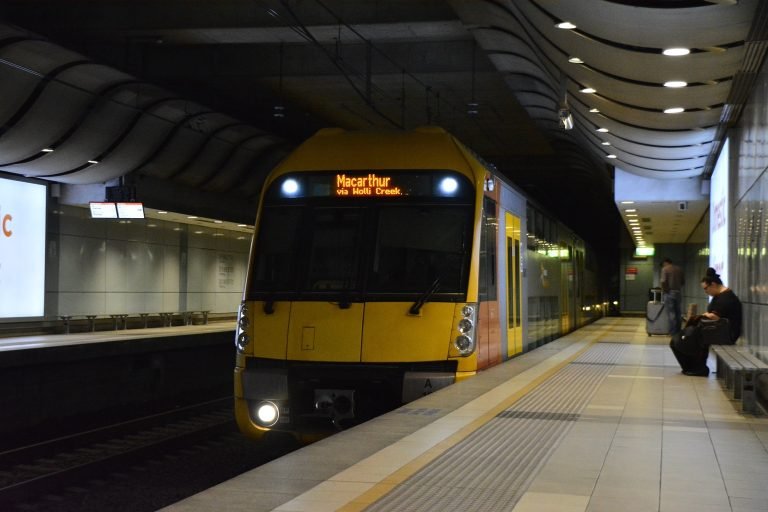
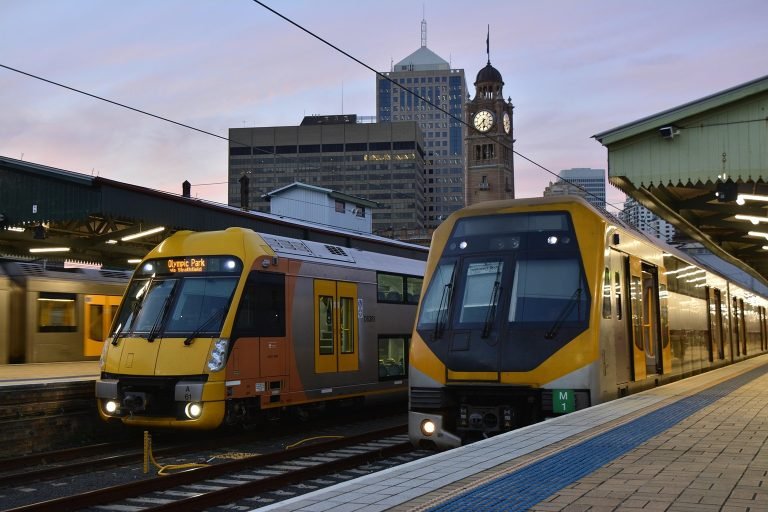
The airport train is the fastest and most straightforward Sydney Airport transport option, connecting both terminals directly to the city in around 15 to 20 minutes. Services run on the T8 Airport & South Line, with frequent departures throughout the day, making it easy to travel without needing to plan around a strict schedule.
Train stations are located directly underneath the terminals. At the Domestic Terminal, you can access the station via lifts or escalators near the baggage claim area. At the International Terminal, the station is a short walk from the arrivals hall with clear signage throughout. The two stations are Domestic Airport Station (Terminals 2 and 3) and International Airport Station (Terminal 1). If you want to check the exact route and stops, you can view the T8 Airport & South Line timetable and route.
Most travelers heading into the city will arrive at Central Station, which is Sydney’s main transport hub, or continue to Circular Quay, located next to the harbour and major attractions. Other useful stops include Town Hall for the CBD and shopping areas, and Wynyard for business districts and nearby hotels.
Once you arrive, it is easy to continue to your hotel using Sydney’s wider transport network. From Central, Town Hall, or Circular Quay, you can transfer to buses, light rail, ferries, or take a short rideshare trip depending on your final destination. If you want a complete overview of how to move between neighborhoods, this Sydney public transport network explained breaks down the system in detail.
In terms of cost, the train is more expensive than standard city transport because of the airport station access fee. Most adult travelers can expect to pay roughly between $20 and $23 for a one-way journey to central Sydney, depending on peak or off-peak times. This price includes both the train fare and the airport station fee, which is automatically added when you tap on or off at the airport stations.
To use the train, you can simply tap on and off at the gates using a contactless credit or debit card, a mobile wallet, or a dedicated transport card. There is no need to purchase a paper ticket unless you specifically prefer one, although these are usually more expensive. If you want a clearer comparison, this Opal and contactless payment guide explains which option is most practical for visitors. If you are planning to use public transport regularly during your stay, this Opal card overview for Sydney transport breaks down how the system works.
The train is fully accessible, with lifts, escalators, and step-free access at both airport stations and major city stops. This makes it one of the most reliable options for travelers with luggage, strollers, or mobility needs.
In practical terms, the train is the best option if you are traveling solo or as a couple, want the fastest connection into the city, and are staying near a train line. However, if you are arriving late at night, carrying multiple large bags, or heading to a neighborhood without direct train access, a rideshare or taxi may be a more convenient choice despite the higher cost.
Uber, Rideshare and Taxis: Convenient Door-to-Door Options
If you prefer a direct and hassle-free journey, rideshare services like Uber or a traditional taxi are among the most convenient Sydney Airport transport options. Unlike the train, these services take you straight from the terminal to your hotel without transfers, making them especially useful after long flights or when traveling with luggage.
Uber operates at Sydney Airport with clearly designated pickup zones at both the International and Domestic terminals. At Terminal 1 (International), Uber pickup is located just outside Arrivals Hall B at Rank C, approximately a short walk from the exit. You simply follow the signs for “Rideshare” or “Priority Pickup,” request your ride through the app, and receive a 6-digit PIN. Instead of waiting for a specific driver, you provide this PIN to the first available Uber driver in the queue. If you want to review the process in detail, you can check the Uber airport pickup guide for Sydney.
At the Domestic Terminals (T2 and T3), Uber pickups are located in the Priority Pickup Zone between the terminals. The process is similar, with clearly marked areas and straightforward instructions inside the app guiding you to the correct location.
In terms of cost, rideshare prices typically range between $35 and $60 to reach central Sydney, depending on demand and traffic conditions. During peak hours or busy travel periods, prices can increase due to surge pricing. Taxis are available from official ranks outside each terminal and usually cost around $45 to $60 to the city, with occasional fixed fares of around $60 for standard vehicles.
Travel time is generally between 20 and 30 minutes, although this can vary depending on traffic, particularly during morning and evening peak hours. Unlike the train, which runs on a fixed schedule, rideshare services and taxis are affected by road conditions, so travel times are less predictable.
Accessibility is well supported, with a dedicated disability access bay available at the International Terminal pickup zone and wheelchair-accessible taxis available on request. Larger rideshare vehicles are also an option for groups or travelers with additional luggage. It is worth noting that public pickup zones offering short free parking are separate from the official rideshare areas, so you should always follow the signs specifically for rideshare or priority pickup.
In practical terms, rideshare or taxis are the best choice if you are traveling in a group, arriving late at night, staying outside the main train network, or simply want the easiest possible transfer. For solo travelers or those staying near major train stations, the train is usually faster and more cost-effective.
Bus and Budget Routes: Cheapest Way from Sydney Airport
Buses are the cheapest way to get from Sydney Airport to the city, but they are also less direct and require more planning compared to trains or rideshare services. While they can save you money, especially if you are traveling light, they are generally slower and often involve at least one transfer to reach central Sydney.
At Terminal 1 (International), bus and coach pickup zones are located on the Arrivals level (ground floor), just outside the terminal. From the arrivals hall, follow the yellow signs for “Bus/Coach” or “Express Pick Up” to reach the correct areas.
Several bus and transfer services operate from these zones:
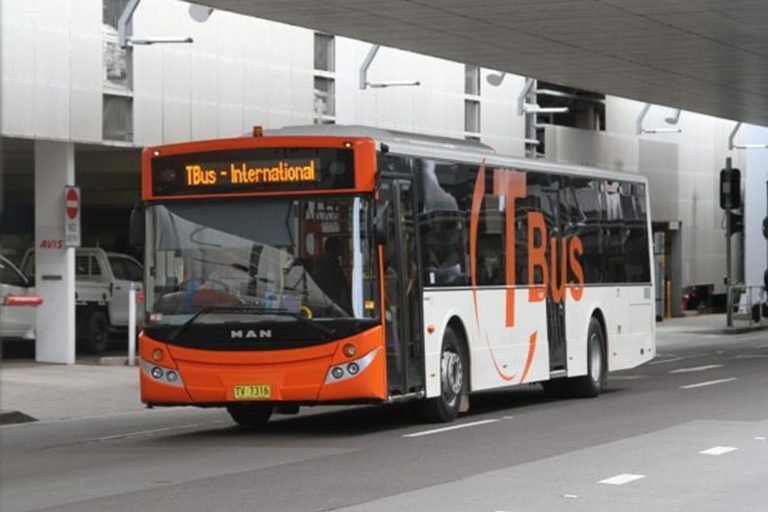
- T-Bus (Airport Transfer): Located outside Arrivals Hall B, this free shuttle connects Terminal 1 with Terminal 2 and Terminal 3 (domestic terminals), making it useful if you have a connecting domestic flight.
- Public Bus 420: The main budget route connecting the airport to suburbs such as Mascot, Rockdale, and Burwood. The most practical option for reaching the city is to take the 420 bus to Mascot Station and transfer to a train.
- Public Bus 350: Runs between the domestic terminals and Bondi Junction via eastern suburbs like Maroubra and Coogee. This route is better suited for coastal destinations rather than the CBD.
- N20 Night Bus: Operates overnight with limited frequency (approximately once per hour), connecting the airport to Town Hall and central Sydney when trains are not running.
- Airport Shuttle Buses / Coaches: Depart from designated bays on the Arrivals level and provide pre-booked, door-to-door transfers to hotels and city locations. These are more comfortable than public buses and a good middle-ground option between budget transport and taxis.
- Express Pick-up (P7 Car Park): Located about a 5–10 minute walk from the terminal, this area is mainly used for private car pickups and families, but it is also clearly signposted from arrivals.
Travel time from the airport to central Sydney by bus is typically around 28–30 minutes or more, depending on traffic and connections. Most public routes do not go directly into the CBD, and instead connect to major hubs like Central Station (Railway Square) or require a transfer.
There is no fast, direct public bus from Sydney Airport to the CBD, and most routes either terminate at hubs like Central Station or require a transfer along the way. As a result, buses are generally slower and less convenient than trains or rideshare options for reaching the city center.
💡 Money-Saving Tip: Instead of taking the train directly from Sydney Airport, take Bus 420 to Mascot Station and continue by train from there. This allows you to avoid the Sydney Airport station access fee, which is around $17–$18 AUD per adult, significantly reducing your total transport cost.
In summary, buses are best suited for budget travelers, those staying along the route, or travelers comfortable navigating Sydney’s transport system. For most visitors heading into central Sydney, the train or a rideshare service will usually be faster and more convenient.
Car Rental: Best for Road Trips, Not for City Stays
Renting a car from Sydney Airport can be a very good option in the right circumstances, but it is not the best choice for every traveler. If you are staying in the CBD, Circular Quay, Darling Harbour, or other central neighborhoods, a car often becomes more of a burden than a benefit. Traffic can be heavy, parking is expensive, and Sydney’s public transport system is usually a far easier way to move around the city.
Where a rental car really makes sense is for the part of your trip that happens beyond the city. If you are planning to drive to the Blue Mountains, explore coastal towns, visit regional New South Wales, or travel with children and a lot of luggage, having your own vehicle gives you flexibility that trains and buses simply cannot match. It allows you to set your own schedule, stop where you want, and reach places that are less practical by public transport.
Picking Up a Rental Car at Sydney Airport
Sydney Airport has major car rental providers at both the international and domestic terminals, including brands such as Avis, Budget, Europcar, Hertz, SIXT, Thrifty, Dollar, and others. At Terminal 1 (International), rental desks are located inside the terminal, and at Terminals 2 and 3 (Domestic), the same general setup applies. In most cases, you collect the paperwork inside the terminal and then walk a short distance to the designated rental car parking area rather than taking a long off-airport shuttle.
That convenience is important after a flight, especially if you are arriving with luggage or traveling as a family. Free baggage trolleys are available in the terminal and nearby parking areas, which makes the pickup process more manageable. If you are arriving at one terminal but need to transfer between terminals before collecting a vehicle, you can use the complimentary T-Bus between T1 and T2/T3, or the paid Airport Link train.
Driving in Sydney: What to Expect
Driving in Sydney itself is often far less relaxing than travelers expect. Roads can be busy, intersections are complex in some areas, and travel times can increase quickly during peak periods. Even if the distance on the map looks short, moving across the city by car can take much longer than expected once traffic builds up.
For this reason, a rental car usually makes the most sense if you plan to leave the city fairly quickly or if your accommodation is outside the main central areas. If your hotel is in the CBD and most of your plans involve city sights, ferries, museums, beaches, or central neighborhoods, public transport, walking, and rideshare services are usually more practical. If you need a broader overview of how the system works once you arrive, this guide to getting around Sydney explains the city’s transport options in more detail.
Tolls and Parking: The Biggest Downsides
The biggest downside of renting a car in Sydney is not the vehicle itself, but the cost of using it in and around the city. Sydney has an extensive toll road network, and many of the faster urban routes are cashless toll roads. That means you cannot simply pay at a booth. You need to make sure your rental company has a toll arrangement in place, or that you understand exactly how toll charges will be passed on to you. If tolls are not handled properly, extra administration charges can be added on top of the road fees.
Parking is another major issue. In central Sydney, daily parking can easily cost around $70 to $80 AUD per day, and in some areas it can be even higher. Cheap parking is very limited, especially near central hotels, major attractions, and beach areas. Parking rules are also enforced strictly, which means that driving into the city without a clear plan can become expensive very quickly.
In practical terms, this means a rental car can be excellent value for a road trip and poor value for a city stay. A car gives freedom once you are outside Sydney, but inside the city it often becomes an extra cost rather than an advantage.
Accessibility and Practicality
Sydney Airport provides accessible infrastructure for travelers collecting rental cars, including lifts, ramps, accessible toilets, and designated accessible parking areas. This makes airport pickup relatively manageable for many travelers with mobility needs. However, if you require a specially adapted or wheelchair-accessible rental vehicle, it is much better to contact the provider directly in advance rather than assume availability on the day.
From a luggage perspective, renting a car can be very practical. If you are arriving with multiple suitcases, sports gear, strollers, or traveling with children, going directly from the terminal to your own vehicle can be much more comfortable than navigating trains or buses.
When Renting a Car Makes Sense
A rental car is a strong choice if Sydney is only the starting point of a wider trip. It works especially well if you plan to drive beyond the city, want to explore regional New South Wales at your own pace, or are traveling in a group where the cost can be shared. It can also make sense if you are staying in outer suburbs or areas where public transport is less convenient.
On the other hand, if your trip is mainly focused on the city itself, keeping a rental car for several days is often unnecessary. In that situation, it can be smarter to rely on trains, ferries, buses, and rideshare services while in Sydney, then rent a car only for the road trip leg of your journey.
Compare Car Rental Options Before You Book
If you decide a rental car makes sense for your trip, it is worth comparing providers before booking. Rates, vehicle types, cancellation flexibility, and pickup conditions can vary significantly between companies, especially at Sydney Airport.
Comparing options in advance can help you find a better rate, avoid unnecessary fees, and choose a vehicle that matches your route, luggage, and travel style more closely.
Best Way to Get from Sydney Airport to the City
If you are unsure which option to choose, here is a simple breakdown of the best way to get from Sydney Airport to the city based on your travel style, budget, and priorities.
- Fastest option: The Airport Link train is the quickest way to reach central Sydney, with direct connections to Central Station, Town Hall, and Circular Quay in around 15–20 minutes.
- Cheapest option: Take Bus 420 to Mascot Station and transfer to a train. This avoids the airport station access fee and is the most budget-friendly route, although it takes longer and requires a transfer.
- Most convenient option: Uber or other rideshare services offer door-to-door transport directly to your hotel, making them the easiest choice if you have luggage or are arriving late.
- Best for groups or families: Uber or taxis can be cost-effective when shared, while also offering more space and direct transport without the need to navigate public transport.
- Best for exploring beyond Sydney: Renting a car is ideal if you are planning a road trip to places like the Blue Mountains or coastal regions, but it is not recommended for staying in the CBD due to parking costs and traffic.
For most travelers staying in central Sydney, the train or a rideshare service will be the best balance between speed, cost, and convenience.
Frequently Asked Questions
• How do I get from Sydney Airport to the city?
You can take the Airport Link train, a rideshare service like Uber, a taxi, or a combination of bus and train. The best option depends on your budget, time, and how much luggage you have.
• What is the cheapest way to get from Sydney Airport to the city?
The cheapest option is to take Bus 420 to Mascot Station and then transfer to a train. This allows you to avoid the airport station access fee and significantly reduce your total cost.
• What is the fastest way to get from Sydney Airport to the city?
The Airport Link train is the fastest option, taking around 15–20 minutes to reach central stations such as Central, Town Hall, and Circular Quay.
• Is there a direct train from Sydney Airport to the city?
Yes, the Airport Link train runs directly from both the international and domestic terminals to central Sydney without requiring a transfer.
• Is Uber cheaper than a taxi from Sydney Airport?
Uber is often slightly cheaper than a taxi, but prices can vary depending on demand, time of day, and traffic conditions. Both offer similar travel times and door-to-door convenience.
• Can I use public transport from Sydney Airport?
Yes, Sydney Airport is well connected by public transport. You can use the Airport Link train, public buses such as the 420 route, or a combination of both to reach the city.
• Where do you arrive in the city from Sydney Airport?
If you take the train, you will arrive at major stations including Central Station, Town Hall, or Circular Quay, depending on your route and final destination.
• Do I need an Opal card at Sydney Airport?
You can use an Opal card, a contactless credit or debit card, or a mobile wallet to pay for public transport. There is no need to purchase a separate ticket in advance.
• Is it worth renting a car in Sydney?
Renting a car is not recommended for staying in the city center due to high parking costs and traffic. It is a better option if you plan to leave Sydney and explore surrounding regions.
• How much is the airport train fee in Sydney?
The airport station access fee is typically around $17–$18 AUD per adult when using the train directly from the airport, which is why some travelers choose alternative routes to reduce costs.
Travel Resources to Plan, Book & Stay Connected
Use these tools and guides to stay connected abroad, find inspiration for your next trip, and book your flights, stays and gear with confidence.
Disclosure: This article may contain affiliate links. If you make a purchase through a link, I may receive a commission at no extra cost to you. I only share recommendations I believe are genuinely useful, and all opinions are my own. AI was used in this post for research and drafting purposes.

Comment (0)