Things to Do in Ninh Binh at a Glance
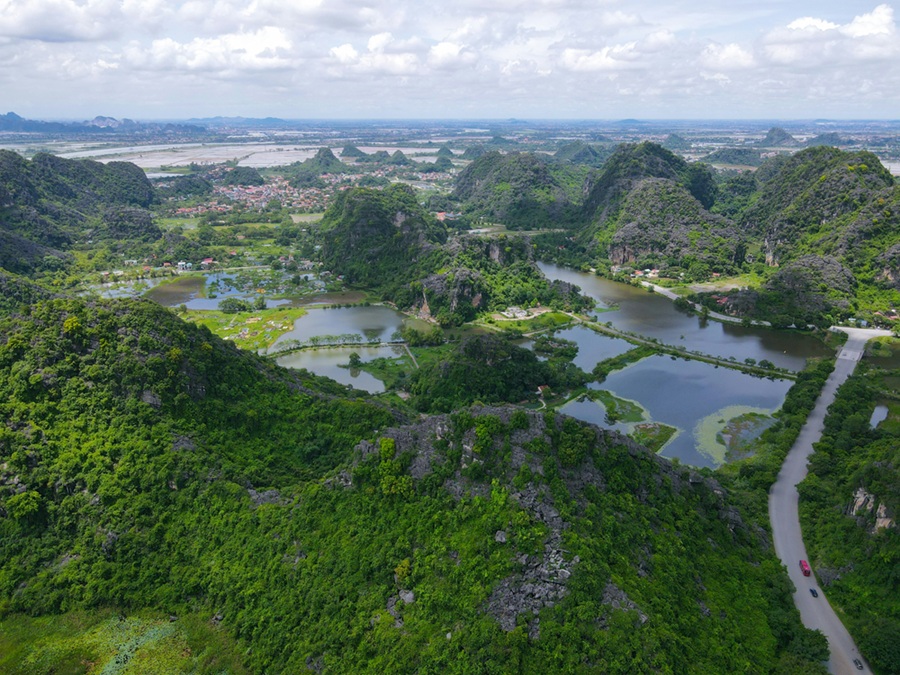
Ninh Binh is one of Northern Vietnam's most spectacular destinations, where limestone karsts rise above rice fields, rivers wind beneath towering cliffs and ancient temples sit among some of the country's most dramatic scenery. If you're wondering what to do in Ninh Binh, these are the essentials to help you start planning your visit.
- Best things to do in Ninh Binh: Take a boat trip through Trang An or Tam Coc, climb to the Hang Mua viewpoint, explore the ancient capital of Hoa Lu, visit Bich Dong Pagoda and discover the enormous Bai Dinh Pagoda complex.
- Best for first-time visitors: Tam Coc makes the most convenient base for most travellers, with accommodation, restaurants and easy access to many of Ninh Binh's major attractions.
- How long to spend in Ninh Binh: Two days gives you enough time to experience several of the highlights without rushing, while three days allows you to explore farther beyond Tam Coc and Trang An.
- Best time to visit: Spring and autumn generally offer comfortable conditions for sightseeing, while late May and early June can bring beautiful green and golden rice-field scenery around Tam Coc.
- Getting around: Cycling is ideal for exploring the countryside around Tam Coc, while scooters, taxis, private drivers and organised tours are useful for reaching attractions farther apart.
- Day trip or overnight stay: Ninh Binh can be visited on a day trip from Hanoi, but staying for at least one night gives you considerably more time to experience the landscape without spending much of the day travelling.
Ninh Binh fits particularly well into a journey through Northern Vietnam. Explore our Things to Do in Vietnam guide for more destinations and experiences, use our Vietnam itinerary to work Ninh Binh into your route, and compare the country's main destinations in our Where to Stay in Vietnam guide.

Things to Do in Ninh Binh: Why This Is One of Northern Vietnam's Most Spectacular Destinations
Ninh Binh looks like the kind of landscape that should be somewhere far more remote. Limestone mountains rise almost vertically from flat rice fields, rivers disappear between towering karsts and small roads wind through a countryside dotted with temples, pagodas and villages. Yet all of this lies only a couple of hours south of Hanoi, making Ninh Binh one of the easiest places to experience rural Northern Vietnam without travelling deep into the mountains.
Many of the best things to do in Ninh Binh revolve around this extraordinary landscape. You can travel by rowing boat beneath the cliffs and through caves at Trang An and Tam Coc, climb hundreds of steps to the panoramic viewpoint at Hang Mua, cycle between rice fields and limestone peaks, and explore historic and religious sites ranging from the ancient capital of Hoa Lu to the enormous Bai Dinh Pagoda complex.
One thing worth understanding before you arrive is that Ninh Binh is much more than Ninh Binh City. Travellers generally use the name to describe the wider destination and its surrounding countryside, while many visitors stay around Tam Coc rather than in the provincial capital itself. The major Ninh Binh attractions are spread across this broader area, so choosing where you stay and how you get around will have a significant effect on your visit.
So, is Ninh Binh worth visiting? Absolutely, particularly if the landscapes are part of what attracts you to Vietnam. Hanoi offers history and intense urban energy, while Ninh Binh replaces crowded streets with rivers, rice fields and immense limestone formations. You can see several highlights on a day trip from Hanoi, but spending two or three days here gives you time to explore beyond the headline sights and experience the countryside at a much slower pace.
What makes Ninh Binh especially rewarding is that the scenery isn't confined to a single viewpoint or attraction. It's around you as you cycle between villages, travel along quiet roads and move from one temple or river valley to another. The famous boat trips and viewpoints may bring you here, but simply travelling through the landscape becomes part of the experience.

Best Things to Do in Ninh Binh
Ninh Binh's greatest attraction is its landscape, but there are several very different ways to experience it. Some of the best things to do in Ninh Binh put you directly on the water beneath the limestone cliffs, while others take you above the karsts for panoramic views or into temples, pagodas and historic sites that reveal a completely different side of the region.
The main Ninh Binh attractions are spread across the countryside rather than concentrated in one town, so don't approach the area as a checklist you can comfortably walk between. Trang An, Tam Coc, Hang Mua, Hoa Lu and Bai Dinh all offer distinctly different experiences, and travelling between them becomes part of exploring the destination.
Take a Boat Ride Through Trang An
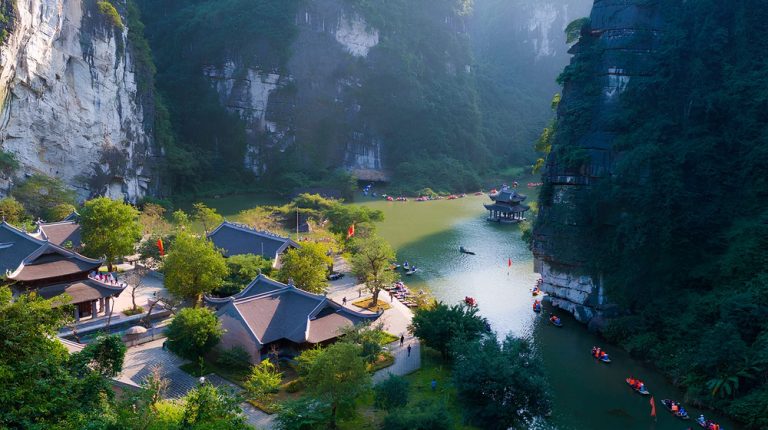
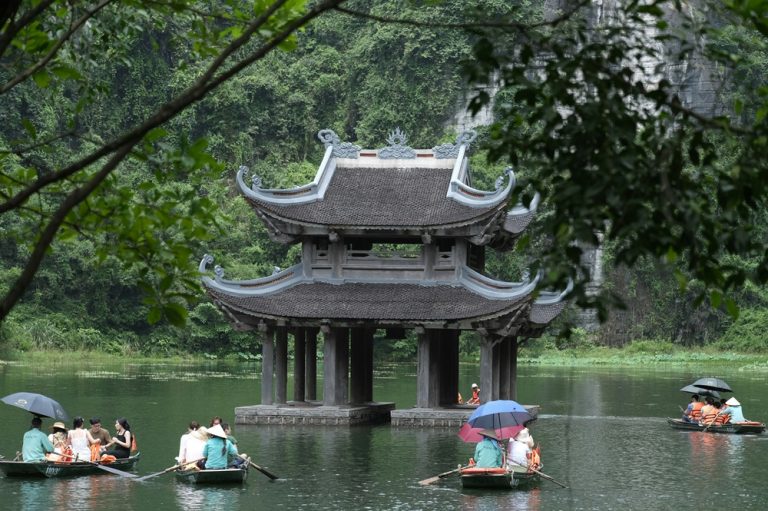
If you only have time for one major experience in Ninh Binh, Trang An is one of the strongest contenders. Small rowing boats carry you along calm waterways enclosed by immense limestone karsts, disappearing periodically into caves before emerging into secluded valleys surrounded almost completely by cliffs.
The setting forms part of the Trang An Landscape Complex, a UNESCO World Heritage Site recognised for both its cultural and natural significance. The protected landscape combines dramatic limestone formations and cave systems with archaeological evidence of human occupation stretching back thousands of years, while temples and other historic sites add another layer to the journey.
A Trang An boat ride isn't simply a continuous cruise through the scenery. Depending on the route operating and the one you choose, you'll travel through different caves and waterways and stop at temples and historic sites along the way. At several stops you can leave the boat briefly before continuing deeper into the landscape.
The caves are one of the experiences that distinguish Trang An from simply looking at Ninh Binh's scenery from the road. The boat enters openings beneath the limestone mountains and continues through passages where the rock can descend surprisingly close overhead. Some passages are short, while others keep you beneath the mountain considerably longer before daylight suddenly reappears at the other side.
Trang An currently operates several sightseeing routes, and they don't all provide exactly the same experience. Some place greater emphasis on caves, while others combine waterways with temples and more open sections of the landscape. Routes and access can change, so it's worth checking the choices available when you arrive rather than becoming too attached to a particular route before your visit.
Allow roughly two and a half to three and a half hours for the boat experience depending on the route and conditions. That may sound like a long time to spend in a small rowing boat, but the changing scenery, cave passages and stops break up the journey. If sitting for long periods is uncomfortable for you, however, this is worth considering before choosing one of the longer routes.
Trang An can become busy with day-trip groups from Hanoi, particularly during popular travel periods. Arriving earlier in the day can give you a better chance of experiencing some of the waterways before the largest groups arrive, although crowd levels vary considerably by day and season. Bring sun protection and water because large parts of the journey are exposed, even though the caves themselves provide occasional relief from the heat.
If you're visiting Ninh Binh independently, you can simply travel to Trang An and arrange the boat ride there. If you're coming from Hanoi or would rather combine Trang An with other Ninh Binh attractions without organising transport yourself, guided tours can package the boat experience with places such as Hoa Lu or Hang Mua.
Glide beneath Ninh Binh's towering limestone karsts and through hidden caves on a Trang An boat ride, or combine the experience with some of the region's other spectacular sights.
Explore Trang An Boat ExperiencesWorldlyRoaming Tip: Don't think of Trang An as something to rush through before moving to the next attraction. Once you're on the water, the slow pace is the point. Leave enough room in your schedule that a longer boat route, queues or an extra temple stop don't leave you watching the clock for the rest of the day.
Explore Tam Coc by Boat
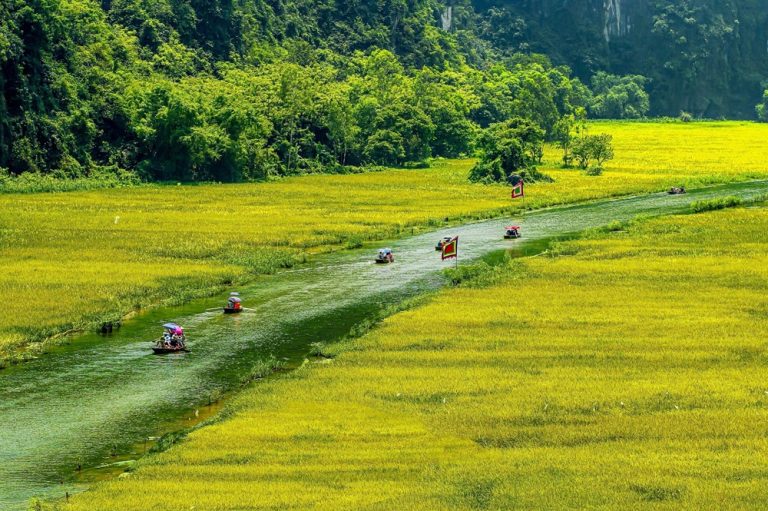
Tam Coc offers another of Ninh Binh's signature boat journeys, but the experience feels noticeably different from Trang An. Instead of travelling through a network of enclosed valleys and stopping at temples along several possible routes, the classic Tam Coc boat ride follows the Ngo Dong River through an open landscape of rice fields and limestone mountains before passing beneath three caves carved through the karsts.
The name Tam Coc literally refers to these three caves: Ca Cave, Hai Cave and Ba Cave. The river flows directly through all three, so there's no need to leave the boat as you approach them. One moment you're floating between fields beneath enormous limestone cliffs and the next you're disappearing underneath the mountain, with the ceiling dropping above the boat before daylight opens up again on the other side.
The journey begins from the boat wharf in Tam Coc and takes roughly two hours for the return trip. That makes it particularly easy to fit into a day of independent sightseeing if you're staying nearby. Unlike Trang An, where getting to the boat complex itself requires a separate journey from most accommodation areas, Tam Coc's boats depart right from the heart of one of Ninh Binh's main traveller bases.
What really distinguishes Tam Coc, however, is the relationship between the river and the surrounding farmland. Rice fields run directly beside sections of the Ngo Dong River, with limestone peaks rising immediately behind them. The landscape changes considerably with the agricultural seasons, from intensely green fields earlier in the growing cycle to the golden rice that has made Tam Coc one of Ninh Binh's most photographed landscapes.
Late May into early June can be particularly spectacular, when the rice beside the river typically reaches its golden harvest period. The exact timing varies from year to year, so don't plan an entire trip around seeing perfectly golden fields on a specific date, but if your visit happens to coincide with the harvest, the boat journey can look completely different from the same landscape at other times of year.
That doesn't mean Tam Coc isn't worth visiting outside rice season. The limestone formations and caves remain impressive throughout the year, and periods when the fields are flooded or intensely green create their own atmosphere. If photography is a major reason for choosing Tam Coc over Trang An, however, the condition of the rice fields can make a significant difference to the scenery you'll experience.
You'll also notice something unusual about some of the rowers: they may propel the boats using their feet. The technique allows experienced rowers to lean back while controlling the oars with their legs, and it has become one of the distinctive sights associated with Tam Coc. Don't be surprised if your boat seems to be moving without anyone rowing in the conventional way.
For current visitor information before you go, the Ninh Binh Tourism Department publishes information about Tam Coc-Bich Dong and other attractions throughout the province.
You can arrange a Tam Coc boat ride independently after reaching the wharf, but organised experiences are particularly useful if you're travelling from Hanoi or want to combine Tam Coc with places such as Hoa Lu and Hang Mua without arranging transport between each attraction yourself.
Drift along the Ngo Dong River between towering limestone peaks, rice fields and Tam Coc's three caves, or combine the boat ride with more of Ninh Binh's countryside and historic sights.
Explore Tam Coc Boat Experiences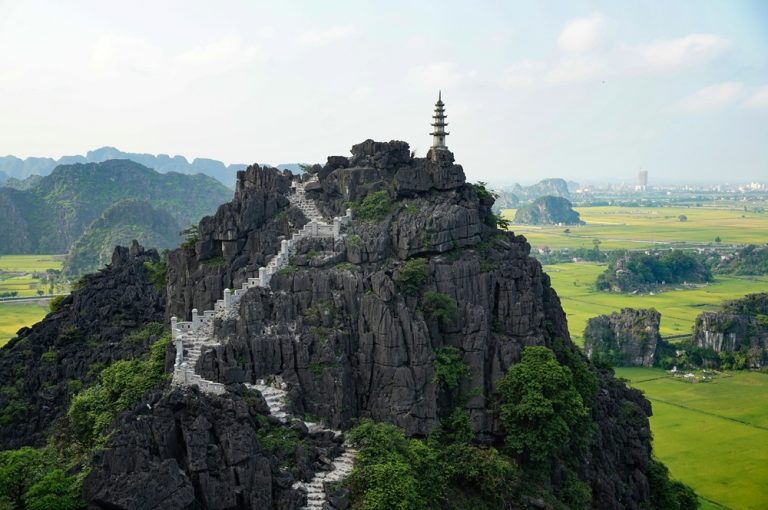
Climb to the Hang Mua Viewpoint
After seeing Ninh Binh from river level at Trang An or Tam Coc, Hang Mua gives you the opposite perspective. A steep stone staircase climbs the limestone mountain above the surrounding countryside, eventually opening onto sweeping views across the karsts, rice fields and waterways below. It's one of the most recognisable viewpoints in Ninh Binh and one of the few places where you can properly appreciate the scale of the landscape from above.
Despite commonly being called Mua Cave, the cave itself isn't the main reason most travellers come here. The real attraction is the climb to the summit of Ngoa Long Mountain. According to the Ninh Binh Tourism Promotion Information Center, the ascent involves nearly 500 stone steps, leading to viewpoints marked by a Buddhist pagoda, a Bodhisattva statue and the stone dragon sculpture that has become one of the defining images of Ninh Binh.
The climb becomes progressively steeper as you gain height, and the stone steps are uneven in places. This isn't a technical hike and you don't need specialist equipment, but it's considerably more strenuous than the short distance might suggest. The upper sections are also exposed, so the difficulty can feel very different depending on the weather and temperature.
Partway up, the staircase divides towards different viewpoints. The most famous route leads towards the stone dragon stretching along the limestone ridge. From this side, you look across the Tam Coc landscape, with the Ngo Dong River winding between rice fields far below and limestone peaks rising across the horizon. The second branch leads towards a pagoda and provides another perspective across the surrounding karst landscape.
If you've already taken the Tam Coc boat ride, the view from Hang Mua is particularly interesting because you're effectively seeing the same landscape from two completely different levels. From the boat, the limestone walls tower above you and restrict how much of the valley you can see at once. From Hang Mua, the pattern suddenly becomes clear: the river curves through the fields while the karsts form enormous natural barriers around it.
The appearance of the view changes significantly with the rice-growing cycle. During the green season, the fields create a vivid contrast with the grey limestone mountains, while around the late-May and early-June harvest period the valley can turn golden. Outside the main growing periods, the fields may look much more subdued, but the height of the viewpoint still makes Hang Mua one of the best places to understand Ninh Binh's unusual geography.
There's more at the base than the mountain staircase itself. The Hang Mua complex also includes gardens and a large lotus pond crossed by wooden walkways. When the lotus flowers are in bloom, this becomes an attraction in its own right and creates a completely different scene from the rocky summit above.
Hang Mua works especially well alongside Tam Coc rather than as a substitute for it. One takes you directly through the river landscape; the other lets you look down across it. If your time in Ninh Binh is limited, combining those two perspectives gives you a much better sense of the landscape than simply moving between several similar ground-level viewpoints.

Discover Hoa Lu Ancient Capital
Ninh Binh's landscapes may dominate the photographs, but the region also played an important role in the formation of Vietnam. Hoa Lu was the country's capital during the Dinh and Early Le dynasties in the 10th and early 11th centuries, before the royal court eventually moved north to Thang Long, present-day Hanoi.
The location wasn't chosen simply for its scenery. Hoa Lu sits within a natural fortress of steep limestone mountains, with the surrounding karsts providing protection at a time when the emerging Vietnamese state faced both internal rivalries and external threats. Standing here today, it's easy to see why this enclosed landscape would have offered such a strategically valuable place from which to rule.
Don't arrive expecting to find an intact ancient city, however. Much of the original capital has disappeared over the centuries, and Hoa Lu today is primarily a historic and religious complex set within the landscape of the former royal capital. The surviving temples, gateways, courtyards and archaeological remains are considerably more meaningful when you understand what once occupied the site.
The two most important monuments are the temples associated with Emperor Dinh Tien Hoang and Emperor Le Dai Hanh. Dinh Tien Hoang established the Dinh dynasty after bringing an end to a period of competing regional warlords and unifying the country in the 10th century. After the Dinh dynasty ended, Le Dai Hanh became the first emperor of the Early Le dynasty and continued ruling from Hoa Lu.
The temples themselves were constructed and restored long after the rulers they commemorate, so they shouldn't be mistaken for surviving royal buildings from the original capital. Instead, they preserve the memory of the two dynasties through traditional Vietnamese temple architecture, statues, altars, carved details and ceremonial spaces.
Hoa Lu's setting is as important to the experience as the monuments. Limestone mountains rise immediately around the former capital, creating a surprisingly enclosed landscape compared with the broad rice fields around Tam Coc. Once you understand that these mountains formed part of Hoa Lu's natural defences, the geography starts to explain why Vietnam's rulers established their capital here more than a thousand years ago.
You don't need as much time at Hoa Lu as you do for a Trang An or Tam Coc boat journey. For most visitors, around one to two hours provides enough time to explore the principal temples and grounds without rushing. That makes Hoa Lu relatively easy to combine with another major Ninh Binh attraction during the same day.
If you're primarily coming to Ninh Binh for the scenery, Hoa Lu provides a useful change of pace between boat trips and viewpoints. It adds the historical context that's easy to miss when travelling through a region where the landscape naturally commands most of your attention.
Hoa Lu is also frequently combined with Trang An, Tam Coc and Hang Mua on organised excursions, making it straightforward to experience the ancient capital alongside Ninh Binh's better-known natural attractions without arranging separate transport between them.
Step into Ninh Binh's royal past at Hoa Lu and combine the ancient capital with the limestone landscapes, rivers and viewpoints that surround Vietnam's former seat of power.
Explore Hoa Lu Experiences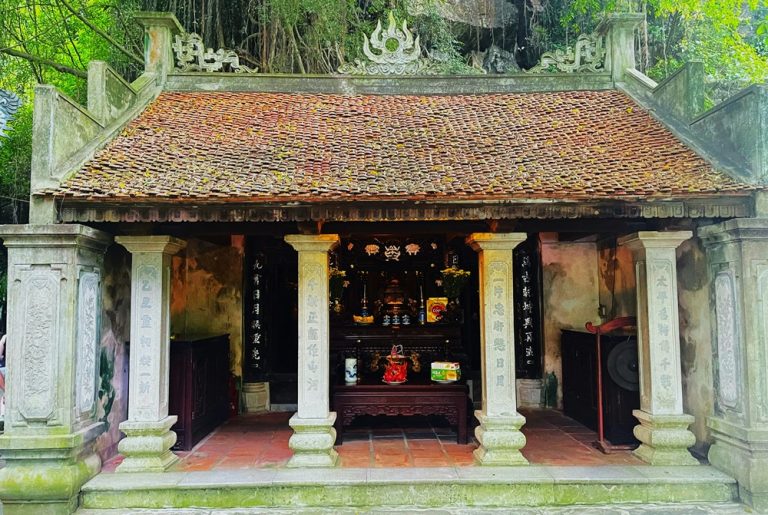
Visit Bich Dong Pagoda
Only a few kilometres from Tam Coc, Bich Dong Pagoda combines Buddhist temples, caves and limestone scenery in a way that feels completely different from the much larger religious complex at Bai Dinh. Rather than occupying a broad open site, Bich Dong climbs directly into the side of a karst mountain, with each level revealing another part of the pagoda as you make your way upward.
The approach is one of the most distinctive in Ninh Binh. A small stone bridge crosses a lotus-filled pond towards an ornate gateway standing beneath the limestone cliffs. Beyond the entrance, the pagoda unfolds across three levels known as Ha Pagoda, Trung Pagoda and Thuong Pagoda, each positioned progressively higher on the mountainside.
Ha Pagoda, the lower temple, is the easiest to reach and sits at the foot of the mountain. From here, stone steps climb towards Trung Pagoda, where Bich Dong starts to become much more unusual. The temple is built partly against the limestone cliff, and the route continues through a natural cave in the mountain rather than simply following an outdoor staircase from one temple to the next.
Inside the cave, Buddhist shrines and statues occupy the shadowy limestone interior before the path emerges again on the other side. The contrast between the dark cave, incense-filled religious spaces and bright countryside outside is a large part of what makes Bich Dong more memorable than its relatively small size might suggest.
Continue climbing and you'll eventually reach Thuong Pagoda, the highest of the three. The upper temple is modest compared with the enormous structures at Bai Dinh, but its position against the mountain gives you views across the surrounding limestone peaks and countryside. The climb is considerably shorter than Hang Mua, so Bich Dong provides some elevation without requiring another major ascent.
Bich Dong remains an active Buddhist site rather than simply a tourist attraction. Dress appropriately when entering the temples, keep voices down around people praying and avoid treating altars or religious statues purely as photographic backdrops. The atmosphere is one of the reasons to visit, particularly once you move beyond the entrance and into the quieter upper sections of the complex.
You can comfortably explore Bich Dong in around one to two hours, depending on how slowly you climb and how much time you spend around the temples and cave. Its location close to Tam Coc also makes it one of the easiest Ninh Binh attractions to combine with a boat trip, countryside cycling or other sights around the area.
If you're exploring without your own transport, Bich Dong is also included in some guided Ninh Binh experiences. These can be useful if you want to combine the pagoda with Tam Coc and other nearby sights rather than arranging each journey separately.
Follow Bich Dong's temples into the limestone mountainside and discover guided experiences combining the pagoda with Tam Coc and the surrounding Ninh Binh countryside.
Explore Bich Dong Experiences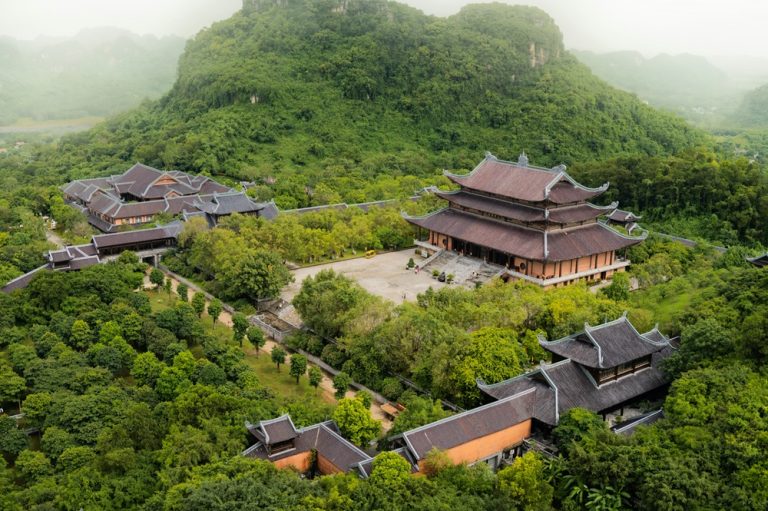
Explore Bai Dinh Pagoda
If Bich Dong feels intimate and closely woven into Ninh Binh's limestone landscape, Bai Dinh Pagoda is almost the complete opposite. This enormous Buddhist complex spreads across a vast area northwest of Hoa Lu, with monumental temple halls, long covered corridors, giant statues and a towering stupa surrounded by the karst scenery of Ninh Binh.
Bai Dinh actually combines two different religious sites. The older pagoda occupies the mountainside and has a history stretching back centuries, while the much larger modern complex below was developed far more recently. Most of the enormous buildings and statues associated with Bai Dinh today belong to this newer section, so it's worth understanding that you're not walking through one intact ancient monastery.
The scale becomes apparent almost immediately. Broad courtyards and stairways connect huge temple halls, while covered corridors lined with hundreds of Arhat statues extend through the complex. Large bronze Buddha statues dominate several of the principal halls, and almost everything here feels deliberately monumental compared with the smaller temples you'll encounter elsewhere around Ninh Binh.
One of the most prominent landmarks is the Bao Thap stupa, which rises above the complex and can be seen from across the surrounding area. From higher points around Bai Dinh, the scale of the site becomes even clearer, with temple roofs spreading below against a backdrop of limestone mountains and countryside.
The older Bai Dinh Pagoda provides a very different experience. Reached on the mountainside above the newer complex, it incorporates caves and shrines into the natural limestone setting. If you have enough time, seeing both sections helps explain why Bai Dinh is more than simply the collection of enormous modern religious buildings that first dominates your attention.
Bai Dinh is also an important place of Buddhist worship and pilgrimage. Although its record-breaking dimensions and giant statues attract considerable attention, approaching it purely as a sightseeing attraction misses much of the purpose of the complex. You'll often encounter worshippers making offerings and praying inside the halls, particularly around important Buddhist festivals and Vietnamese holidays.
Don't underestimate the distances involved here. Bai Dinh is far larger than a conventional temple visit, and exploring the complex entirely on foot involves substantial walking between different areas. Electric vehicles operate within the site and can reduce some of those distances, particularly useful if you want to see several major sections without spending much of your visit simply walking between them.
Allow at least two to three hours if you want more than a quick look at the main modern complex, and considerably longer if you intend to explore both the newer site and the older pagoda properly. Travellers with little interest in Buddhist architecture may find Bich Dong more atmospheric and manageable, but if you want to experience the sheer scale of contemporary Vietnamese Buddhist architecture, Bai Dinh offers something completely different from Ninh Binh's smaller religious sites.
Bai Dinh is some distance from Tam Coc and is frequently paired with Trang An and other attractions on organised excursions. A tour can make particular sense if you don't have your own transport and want to combine the enormous temple complex with Ninh Binh's river and karst landscapes during the same day.
Walk among monumental Buddha statues, vast temple halls and sweeping mountain scenery at Bai Dinh, or combine the pagoda with Trang An and more of Ninh Binh in a single experience.
Explore Bai Dinh Experiences
Visit Thung Nham Bird Park
After Ninh Binh's boat routes, viewpoints and temples, Thung Nham Bird Park offers a quieter way to experience the region's limestone landscape. Set among wetlands, forest and karst mountains southwest of Tam Coc, Thung Nham is a large nature and ecotourism area rather than simply a conventional bird park.
The main attraction is the bird garden, a protected wetland area where numerous species of birds feed and roost among the trees. Egrets and herons are among the most easily recognised residents, alongside other waterbirds and species that inhabit the surrounding forest and wetlands.
Timing makes a genuine difference here. During much of the day, birds are dispersed across the wider area feeding, so arriving at the bird garden in the middle of the day can be underwhelming if wildlife is your main reason for visiting. Late afternoon is generally the most rewarding period, when increasing numbers of birds return towards their nesting and roosting areas and the trees can become noticeably more active.
The wider Thung Nham Ecotourism Area contains much more than the bird garden. Walking paths lead through landscaped grounds and forest beneath the limestone mountains, while caves and waterways provide additional places to explore. You can also take short boat journeys through parts of the wetland and cave landscape, giving the area a different character from the much longer sightseeing routes at Trang An and Tam Coc.
One of the better-known caves is But Cave, a long natural cave running through the limestone mountain. Other sites around the complex include Vai Gioi Cave and several gardens and viewpoints, although you don't need to treat every named attraction on the map as something that must be checked off. Thung Nham works better when approached as a few slower hours in nature rather than another packed sightseeing itinerary.
The setting itself is a large part of the appeal. Limestone cliffs rise behind lakes and wetlands, forest covers parts of the surrounding karsts and the atmosphere becomes increasingly peaceful as you move away from the more developed areas of the complex. If you've spent the previous day moving between Ninh Binh's headline attractions, Thung Nham can provide a welcome change of pace.
Allow around three to four hours if you want to explore some of the wider grounds before finishing at the bird garden. Travellers primarily interested in birdlife should plan their visit around the roosting activity rather than simply arriving whenever Thung Nham happens to fit between other attractions.
Thung Nham is particularly easy to combine with Tam Coc and Bich Dong because all three are in the same general part of Ninh Binh. Guided experiences are also available if you'd rather combine the bird park and surrounding countryside without arranging your own transport.
Trade Ninh Binh's busiest sights for wetlands, caves and forest at Thung Nham, where the experience changes as birds begin returning to their roosts across the limestone landscape.
Explore Thung Nham ExperiencesWorldlyRoaming Tip: Don't make the bird garden your first stop when you arrive. Explore the caves, paths and wider Thung Nham grounds first, then make your way to the bird area later in the afternoon as birds begin returning to roost. In this case, changing the order of your visit can genuinely change what you see.

Explore Van Long Nature Reserve
If Trang An and Tam Coc show you Ninh Binh's most famous river landscapes, Van Long Nature Reserve offers a quieter and more wildlife-focused alternative. This extensive wetland lies north of the main Tam Coc and Trang An sightseeing area, where shallow water spreads beneath limestone mountains and large sections of the landscape remain protected as habitat rather than developed primarily for tourism.
The main way to experience Van Long is from a small traditional rowing boat. The journey takes you slowly across the wetland beneath steep limestone cliffs, passing reeds, aquatic vegetation and rocky outcrops reflected in remarkably calm water. There are fewer elaborate temples and tourist facilities along the route than at Trang An, and that's precisely part of Van Long's appeal.
Van Long is sometimes described as the "bay without waves" because of its exceptionally still water. When conditions are calm, the surface can act almost like a mirror, reflecting the limestone peaks above it. The boats are small and move quietly through shallow sections of the reserve, creating an experience that feels much more intimate than Ninh Binh's busier boat attractions.
Wildlife is the other major reason to come here. The limestone mountains around Van Long provide important habitat for the critically endangered Delacour's langur, a primate found only in Vietnam. Van Long protects one of the species' most important remaining populations, and the possibility of seeing langurs moving across the limestone cliffs gives the reserve a completely different dimension from Tam Coc or Trang An.
A sighting is never guaranteed. The langurs live on steep rocky slopes and may be difficult to spot, particularly when they're resting among vegetation or remaining higher on the cliffs. Treat seeing them as a bonus rather than the sole reason for visiting. Even without a langur sighting, the wetland supports numerous birds and other wildlife and remains one of Ninh Binh's most peaceful landscapes to explore from the water.
The Van Long boat ride is also considerably simpler than the elaborate routes through Trang An. You won't spend several hours moving through a sequence of temples, caves and valleys. Instead, the experience is about moving slowly through an open wetland beneath the karsts, watching the cliffs and vegetation for wildlife and enjoying a landscape with far less infrastructure around it.
That distinction matters when deciding whether Van Long deserves space in your Ninh Binh itinerary. If you only have one day and want the most dramatic introduction to the region, Trang An or Tam Coc will generally make more sense. If you have several days, enjoy wildlife or specifically want to experience somewhere quieter beyond Ninh Binh's headline attractions, Van Long becomes much more compelling.
Van Long is farther from Tam Coc than many of the attractions we've covered so far, which can make independent transport less convenient. Guided experiences that include the reserve are therefore particularly useful if Van Long is one of your priorities but you don't want to organise a scooter, taxi or private driver for the journey.
Leave Ninh Binh's busiest boat routes behind and explore the still wetlands of Van Long, where limestone cliffs, birdlife and the possibility of spotting rare Delacour's langurs create a very different journey on the water.
Explore Van Long Experiences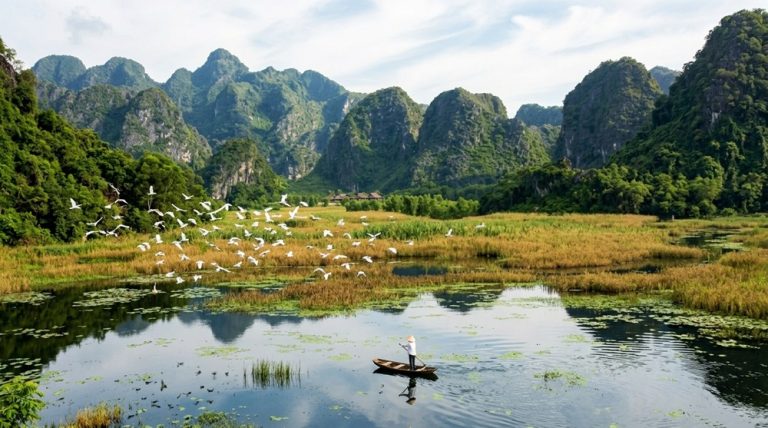
Discover Cuc Phuong National Park
Ninh Binh isn't only about rivers, rice fields and exposed limestone karsts. Travel west from the main sightseeing area and the landscape changes dramatically at Cuc Phuong National Park, where limestone mountains are covered by dense tropical forest and hiking trails lead to caves, ancient trees and some of the region's most important wildlife conservation projects.
Established in 1962, Cuc Phuong National Park was Vietnam's first national park. It covers more than 22,000 hectares across Ninh Binh, Hoa Binh and Thanh Hoa provinces and protects an exceptionally diverse limestone-forest ecosystem. The park records more than 2,000 plant species alongside hundreds of species of birds, mammals, reptiles and amphibians.
For most visitors, hiking is the best way to experience Cuc Phuong. Trails range from relatively accessible forest walks to much longer treks, so you don't need to commit to an expedition to get beneath the canopy. Some of the most popular routes lead towards enormous ancient trees, where the size of the trunks and dense vegetation give you a much better sense of the age and scale of the forest than you'll get from simply driving through the park.
Cuc Phuong's limestone landscape also contains caves with significant archaeological evidence. The best known is the Cave of Prehistoric Man, where archaeological discoveries revealed evidence of people living in the area thousands of years ago. It adds an unexpected human-history element to a park that most travellers initially visit for its forest and wildlife.
One of Cuc Phuong's most important roles today is wildlife conservation. The park is home to the Endangered Primate Rescue Center, established to rescue, rehabilitate, breed and conserve some of Vietnam's most threatened primates. Its work has involved species including Delacour's langurs, Hatinh langurs and several other primates threatened by habitat loss and the illegal wildlife trade.
Other conservation initiatives associated with Cuc Phuong focus on turtles, carnivores and pangolins. Visitor access and activities connected with the conservation centres can change, so if seeing one of them is important to you, check the current arrangements with the park rather than assuming every facility will automatically be open as part of a standard visit.
Wildlife expectations also need to be realistic. Cuc Phuong protects an impressive range of mammals and birds, but a daytime walk through tropical forest isn't a wildlife safari. Many mammals are elusive, nocturnal or live high in the canopy, and dense vegetation makes animals surprisingly difficult to see even when they're nearby. The forest itself, its biodiversity and the conservation work should be part of the reason you come rather than expecting encounters with rare animals along every trail.
One natural spectacle is much easier to appreciate at the right time of year. During April and May, large numbers of butterflies can emerge throughout Cuc Phuong, sometimes gathering along forest roads and trails in remarkable concentrations. The precise timing and intensity depend on weather and seasonal conditions, so it's never something to guarantee on a particular date, but visitors arriving during this period may experience a completely different-looking forest.
Cuc Phuong deserves more time than most individual Ninh Binh attractions. A full day gives you enough time to travel into the park, hike through the forest and visit several of its major sites without treating the journey as a race. Longer treks and overnight experiences are also possible if the national park itself is one of the main reasons you're visiting the region.
Because Cuc Phuong lies well beyond the main Tam Coc-Trang An sightseeing circuit, it makes most sense for travellers with at least three days in Ninh Binh or anyone with a particular interest in forests, hiking and conservation. With only a day or two, the travel time involved means most first-time visitors will get more from concentrating on Ninh Binh's central karst landscapes.
Getting there independently generally requires your own transport, a taxi or a private driver. Organised trips remove that logistical problem and can combine transport with guided exploration of the forest, which is particularly useful if you'd rather understand what you're seeing than simply follow one of the park's trails independently.
Leave Ninh Binh's rice fields behind and head into Vietnam's oldest national park, where tropical forest, ancient trees, caves and wildlife conservation reveal an entirely different side of the region.
Explore Cuc Phuong Experiences
Cycle Through the Ninh Binh Countryside
Some of Ninh Binh's most enjoyable scenery isn't inside an attraction at all. Around Tam Coc, narrow roads and lanes run between rice fields, limestone mountains, waterways and small villages, making cycling one of the best ways to experience the countryside rather than simply travelling from one famous sight to another.
The landscape around Tam Coc is particularly well suited to cycling. Much of the terrain between the karsts is relatively flat, and once you move away from the busier roads, you can follow smaller lanes through farmland with limestone peaks rising immediately beside you. Distances are short enough that you can explore without turning the ride into a serious cycling expedition.
One of the easiest rides is from Tam Coc towards Bich Dong Pagoda. The route takes you out of the main tourist centre and into increasingly rural surroundings before reaching the pagoda beneath the mountains. Rather than simply cycling there and returning along exactly the same road, allow time to follow some of the smaller lanes branching through the surrounding countryside.
This is where cycling in Ninh Binh becomes more than transportation. You pass fields being worked, water buffalo grazing beside the road, village homes, small temples and waterways that barely register when you're travelling past them in a car. There may be no named attraction at the end of a particular lane, but the combination of everyday rural life and the enormous karsts surrounding it is part of what makes Ninh Binh memorable.
The scenery changes dramatically with the agricultural cycle. At some times of year you'll cycle beside intensely green paddies, while the period approaching the rice harvest can transform parts of the valley into fields of gold. At other times, recently harvested or flooded fields create a much more muted landscape. Ninh Binh doesn't look identical throughout the year, and cycling makes those seasonal changes particularly noticeable.
Bicycles are widely available from hotels, homestays and rental businesses around Tam Coc, and some accommodation includes them for guests. For casual countryside exploration, a simple city bike is usually sufficient. If you're planning a much longer ride or want to explore farther from Tam Coc, it's worth checking the condition of the brakes, tyres and gears before setting off rather than assuming every rental bicycle is equally well maintained.
A bicycle isn't the best solution for every Ninh Binh attraction. Places such as Bai Dinh, Van Long and Cuc Phuong are much farther away, and trying to connect the entire region by bicycle can turn a relaxing countryside experience into a long day on larger roads. Use a bike for the compact countryside around Tam Coc and Bich Dong, then rely on a scooter, taxi, driver or tour for attractions farther afield.
If you'd rather explore beyond the obvious roads without working out a route yourself, guided bike tours can take you deeper into the countryside and combine cycling with villages, temples and other parts of rural Ninh Binh that are easy to pass by when you're focused on navigating.
Pedal beyond Ninh Binh's headline sights and follow quiet lanes between rice fields, villages and towering karsts with a local guide who knows where the countryside becomes most rewarding.
Explore Ninh Binh Bike Tours
Visit Hoa Lu Old Town
Despite the name, Hoa Lu Old Town should not be confused with Hoa Lu Ancient Capital. The ancient capital is the historic site where Vietnam's Dinh and Early Le rulers established their royal centre more than a thousand years ago. Hoa Lu Old Town, by contrast, is a modern cultural and tourism development in Ninh Binh City designed around traditional Vietnamese architecture, crafts, food and evening entertainment.
The Old Town sits beside Ky Lan Lake and Ky Lan Mountain, creating an attractive setting that becomes particularly atmospheric after dark. Traditional-style buildings line the waterfront, while lanterns and illuminated architectural details reflect across the lake once evening arrives.
This is precisely why Hoa Lu Old Town makes more sense as an evening experience than as a daytime sightseeing priority. During daylight hours, your time in Ninh Binh is better spent exploring places such as Trang An, Tam Coc, Hang Mua or the historic Hoa Lu Ancient Capital. Once those attractions begin winding down, the Old Town gives you somewhere completely different to spend the evening.
The pedestrian areas contain shops and stalls selling local products, handicrafts, souvenirs and food, with the architecture drawing inspiration from traditional Vietnamese styles. Cultural performances and events are also held here at certain times, although the exact programme varies rather than following a schedule every visitor can rely on.
Small boat rides on Ky Lan Lake add another perspective after dark, when the illuminated buildings, lanterns and mountain backdrop are reflected across the water. It's a much shorter and more urban experience than the famous boat journeys at Trang An or Tam Coc, so think of it as part of an evening out rather than another major Ninh Binh river excursion.
Hoa Lu Old Town is especially convenient if you're staying in Ninh Binh City, where you can visit without sacrificing daytime sightseeing elsewhere in the province. If you're based in Tam Coc, you'll need to travel into the city, so whether it's worth making the journey depends largely on how much time you have and whether you're looking for something different to do after dinner.
The distinction between the two Hoa Lu attractions is worth remembering when planning your itinerary: Hoa Lu Ancient Capital is a historical attraction; Hoa Lu Old Town is a modern evening destination. They serve completely different purposes, and visiting one shouldn't be treated as a substitute for visiting the other.
If you'd like to experience Hoa Lu Old Town as part of a broader exploration of Ninh Binh, guided experiences can combine the area's cultural sights with other attractions and take care of transport between locations.
See another side of Ninh Binh after dark, when Hoa Lu Old Town's lanterns, traditional-style architecture and lakeside setting transform the foot of Ky Lan Mountain.
Explore Hoa Lu Old Town Experiences
Visit Phat Diem Cathedral
One of Ninh Binh's most unusual attractions lies well beyond the familiar karst scenery around Tam Coc and Trang An. Phat Diem Cathedral is a Catholic religious complex whose architecture draws heavily on traditional Vietnamese design, creating a combination that looks unlike almost any conventional European-style cathedral.
The complex was developed in the late 19th century under the direction of Vietnamese priest Father Peter Tran Luc, commonly known as Père Six. Rather than simply reproducing Western church architecture, Phat Diem was constructed using forms, materials and decorative elements associated with Vietnamese temples, pagodas and traditional communal buildings.
That fusion is apparent before you even enter the main cathedral. One of the complex's most distinctive structures is the monumental Phuong Dinh bell house, built primarily from stone and resembling a large traditional Vietnamese gateway or communal building more than a European church tower. Its broad, tiered roofs and massive stone construction immediately establish the architectural character of the site.
The main cathedral continues the combination of traditions. Its sweeping tiled roofs, carved timber columns and richly decorated interior draw heavily on Vietnamese architectural forms, while the layout, altar and religious imagery reflect its Catholic purpose. Look closely at the decorative details and you'll find Christian symbols incorporated alongside motifs familiar from traditional Vietnamese art.
Phat Diem is actually a large religious complex rather than a single church. Several smaller chapels stand around the main cathedral, together with courtyards, religious monuments and an artificial lake. Particularly distinctive is the small stone church dedicated to the Immaculate Heart of Mary, whose structure and interior make extensive use of carved stone.
The result is more interesting than simply describing Phat Diem as a cathedral that “looks like a pagoda.” The complex represents an attempt to express Catholic worship through a distinctly Vietnamese architectural language, combining traditions rather than allowing one to completely replace the other. That makes it worthwhile even if churches aren't normally high on your sightseeing list.
Phat Diem remains an active Catholic religious centre, so visitors should treat the buildings as places of worship rather than museum exhibits. Masses and religious ceremonies continue to take place here, and access to parts of the complex may occasionally be affected by services or important Catholic celebrations.
The main drawback is location. Phat Diem lies roughly 30 kilometres south of Ninh Binh City and considerably farther from the main Tam Coc-Trang An sightseeing circuit. That makes it difficult to justify on a rushed day trip from Hanoi, particularly when you're visiting Ninh Binh for the first time and still haven't seen its major landscapes.
With three days or longer, however, Phat Diem becomes much easier to recommend. The journey takes you away from Ninh Binh's busiest tourist zone and gives you an attraction that bears almost no resemblance to the boat trips, viewpoints and Buddhist temples dominating the rest of the region.
Travellers without their own transport can also visit Phat Diem as part of a guided experience, avoiding the need to arrange a separate return journey to one of Ninh Binh's more distant cultural attractions.
Venture beyond Ninh Binh's familiar karst landscapes to Phat Diem, where Catholic traditions meet extraordinary Vietnamese architecture in one of the region's most distinctive religious complexes.
Explore Phat Diem Experiences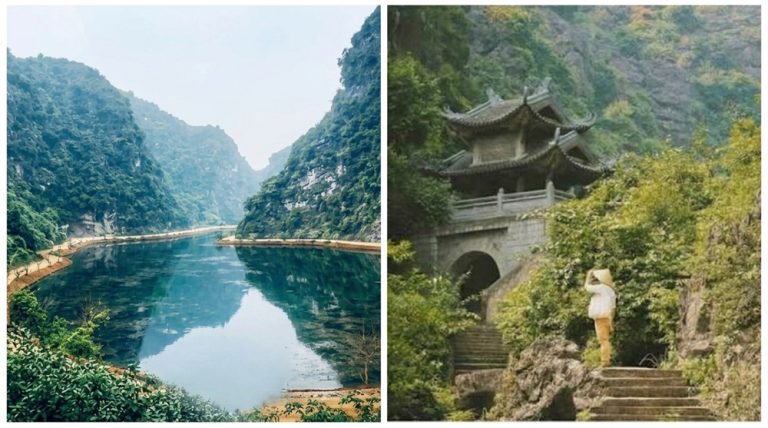
Explore Am Tien Cave and Tuyet Tinh Coc
Close to Hoa Lu Ancient Capital, Am Tien Cave and Tuyet Tinh Coc sit within an enclosed limestone valley that feels surprisingly secluded despite its proximity to some of Ninh Binh's major attractions. Steep karst walls surround an emerald-green lake, with a road and walking path following the water beneath the mountains.
You'll often see the destination referred to simply as Tuyet Tinh Coc, while Am Tien Cave and Am Tien Pagoda are among the principal sights within the area. The different names can make it appear that they're separate destinations when planning your trip, but they're part of the same attraction and can easily be explored together.
The entrance leads through the limestone mountain before opening into the enclosed valley beyond. This sudden transition is one of the most striking parts of the experience: the surrounding cliffs largely cut the lake off from the outside landscape, creating an atmosphere very different from the broad rice fields around Tam Coc or the interconnected waterways of Trang An.
A path follows the edge of the lake, allowing you to explore the valley on foot before climbing towards Am Tien Pagoda and cave on the mountainside. From higher ground, you can look back across the water towards the limestone walls enclosing the site.
Am Tien also has connections with the history of the nearby Dinh dynasty. The area is associated with Emperor Dinh Tien Hoang and Queen Duong Van Nga, and various stories surrounding the site combine recorded history with legends that have developed over centuries. That historical connection makes considerably more sense when Am Tien is visited alongside Hoa Lu Ancient Capital rather than treated purely as a scenic lake.
The cave and pagoda add a spiritual dimension to the landscape. Buddhist shrines occupy the limestone setting, and the combination of water, mountain and religious architecture gives Am Tien a quieter character than the monumental scale of Bai Dinh or the more heavily visited temple complex at Hoa Lu.
You don't need an entire day for Tuyet Tinh Coc. Allow roughly one to two hours to walk around the lake, explore the cave and pagoda area and enjoy the views without rushing. Its location makes it particularly easy to combine with Hoa Lu Ancient Capital during the same part of your itinerary.
For a first visit to Ninh Binh, Am Tien remains secondary to experiences such as Trang An, Tam Coc and Hang Mua. Once you have additional time, however, it's a worthwhile addition precisely because it combines several elements of Ninh Binh—karst scenery, water, history and religion—within one compact site.
There are also organised itineraries that make Am Tien much more than an isolated stop. The experience below combines Am Tien Cave and Tuyet Tinh Coc with Hoa Lu Ancient Capital, a Trang An boat ride and the climb to Hang Mua, effectively linking the area's history, river landscape and panoramic viewpoints into one day.
Go beyond Tuyet Tinh Coc's emerald lake on a full Ninh Binh experience combining Am Tien Cave and Hoa Lu's ancient history with a Trang An boat journey and the panoramic climb to Hang Mua.
Explore the Full Ninh Binh Experience
Visit Thai Vi Temple
Tucked into the countryside just outside Tam Coc, Thai Vi Temple is one of Ninh Binh's smaller historical attractions. It doesn't have the scale of Bai Dinh or the dramatic mountainside setting of Bich Dong, but its location among rice fields and limestone karsts makes it an easy and worthwhile stop while exploring the area around Tam Coc.
The temple is closely associated with Vietnam's Tran dynasty, which ruled from the 13th to the early 15th century. It honours several members of the Tran royal family, including emperors who played important roles during a period when the dynasty successfully resisted Mongol invasions of Vietnam.
Thai Vi's architecture is relatively modest compared with Ninh Binh's larger religious complexes, but the details reward a closer look. Stone features prominently throughout the temple, including carved columns and decorative elements, alongside the tiled roofs, courtyards, altars and timber structures characteristic of traditional Vietnamese religious architecture.
The setting is arguably as important as the temple itself. Thai Vi sits beneath limestone mountains in a quiet valley, and the roads approaching it pass through the same rice-field landscape that makes the countryside around Tam Coc so enjoyable to explore. There are none of the enormous courtyards or monumental structures you'll encounter at Bai Dinh, and a visit feels considerably more intimate.
You won't need several hours here. Thirty minutes to an hour is generally enough to explore the temple and its immediate surroundings, making Thai Vi much better suited to being incorporated into a wider day of countryside exploration than treated as a standalone excursion.
One of the best ways to do that is by bicycle. From Tam Coc, you can ride through the surrounding countryside towards Thai Vi and continue exploring the smaller roads between the karsts rather than making a dedicated return journey purely to see the temple. It fits particularly naturally into the kind of unhurried cycling route we described earlier in this guide.
Guided Ninh Binh experiences also include Thai Vi in itineraries combining the temple with the surrounding countryside and other nearby sights, which can be useful if you're interested in the area's history but don't want to plan the route independently.
Follow the quieter roads beyond Tam Coc to Thai Vi Temple and discover the Tran dynasty history hidden among Ninh Binh's rice fields and limestone mountains.
Explore Thai Vi Temple Experiences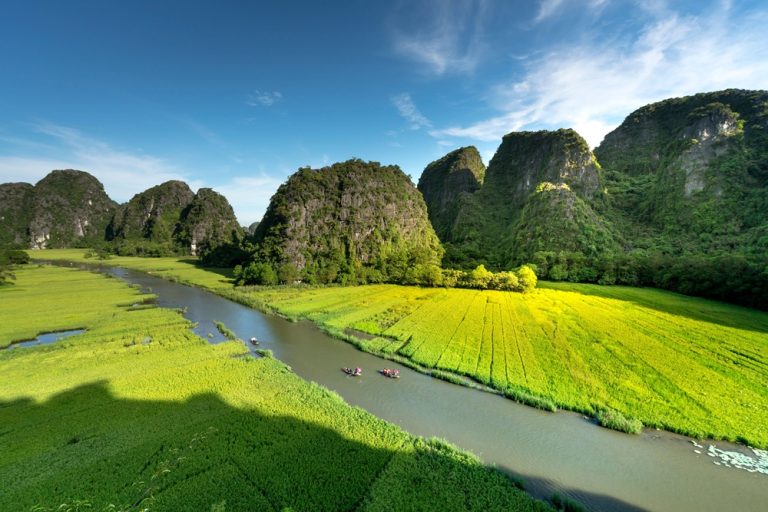
Trang An vs Tam Coc: Which Boat Trip Should You Choose?
Trang An and Tam Coc are Ninh Binh's two signature boat experiences. Both take you through spectacular limestone scenery in small rowing boats, but Trang An and Tam Coc aren't interchangeable. If you only have time for one, the choice mainly comes down to whether you want a more varied karst-and-cave experience or open river scenery surrounded by rice fields.
| What to Compare | Trang An | Tam Coc |
|---|---|---|
| Landscape | Enclosed valleys, waterways and dramatic limestone karsts | Open river scenery, rice fields and limestone mountains |
| Caves | Multiple cave passages, varying by route | A straightforward journey through the three caves that give Tam Coc its name |
| Cultural stops | Several routes include temples and historic sites | Primarily a continuous river journey focused on scenery |
| Rice fields | Less prominent | A defining feature, particularly when green or approaching harvest |
| Time needed | Generally longer, depending on the route | Around two hours for the classic return journey |
| From Tam Coc | Requires transport to the departure complex | Boats depart directly from central Tam Coc |
| Best for | The most complete all-round boat experience | Rice fields, photography and convenience |
👉 On mobile, slide right to view the full table.
Choose Trang An for the Most Complete Experience
If this is your first visit and you can only take one boat trip, we would choose Trang An. Its waterways pass beneath towering karsts, through caves and into enclosed valleys, while different routes can also include temples and historic sites.
The result is a more varied journey than Tam Coc. Emerging from a cave into another valley completely surrounded by mountains also gives Trang An a distinctive sense of discovery. If you simply want the strongest all-round introduction to Ninh Binh's limestone-and-water landscape, Trang An is our choice.
Choose Tam Coc for Rice Fields and Open Scenery
Choose Tam Coc if the Ninh Binh landscape you want to see is a river winding through rice fields beneath limestone peaks. The Ngo Dong River passes directly through agricultural land, making the rice-growing cycle a much more important part of the experience.
This is particularly relevant around late May and early June, when favourable harvest timing can turn the fields golden. During good rice conditions, we would choose Tam Coc over Trang An if rice-field scenery is your priority.
Tam Coc is also more convenient if you're staying nearby. Boats leave from central Tam Coc, and the trip combines easily with Bich Dong, Hang Mua, Thai Vi Temple or cycling through the surrounding countryside.
Which Is Better for Photography?
Tam Coc is better for classic rice-field photography, particularly when the fields are vivid green or approaching their golden harvest. Its open landscape provides broader views across the river, fields and surrounding karsts.
Trang An offers a different photographic experience: dramatic limestone walls, cave entrances, temples and boats moving through narrow waterways. Combining Tam Coc with Hang Mua is particularly rewarding for photographers because you can see the same valley from river level and from the viewpoint above.
Is It Worth Doing Both Trang An and Tam Coc?
If you have only one day, probably not. Both trips require several hours in a rowing boat, and doing both leaves little time for Hang Mua, Hoa Lu or other attractions.
With two or three days in Ninh Binh, doing both can be worthwhile because the landscapes are genuinely different. Trang An provides caves, enclosed waterways and cultural stops; Tam Coc provides an open river and agricultural scenery.
If you choose both, take them on separate days rather than back-to-back. Combine Trang An with Hoa Lu or nearby historical sites, and Tam Coc with Bich Dong, Hang Mua or countryside cycling.
Trang An or Tam Coc: Our Verdict
If you can only choose one, choose Trang An. It's the more varied boat journey and the strongest all-round introduction to Ninh Binh's karst landscape.
Choose Tam Coc instead if rice fields and photography are your priority, particularly during favourable growing or harvest conditions, or if you want the convenience of departing directly from central Tam Coc.
If you have enough time, do both on separate days. You'll experience two distinct versions of the landscape rather than spending most of a single sightseeing day sitting in boats.

What to Eat in Ninh Binh
Ninh Binh has several regional specialties, but the two you'll encounter most often are mountain goat and cơm cháy. You don't need to make food a major part of your itinerary, but both are worth trying while you're here.
Try Ninh Binh Mountain Goat
Dê núi Ninh Bình, or Ninh Binh mountain goat, is the province's best-known specialty. Restaurants prepare it in numerous ways, including grilled, steamed, stir-fried, in hotpots and with lemongrass and chilli.
One distinctive preparation is dê tái chanh, made with thinly sliced goat, lime, herbs and accompaniments. If you've never eaten goat before, consider sharing several smaller preparations rather than ordering one large dish so you can try different flavours and cooking styles.
Eat Cơm Cháy, Ninh Binh's Crispy Rice
Cơm cháy is crispy rice made by drying and frying cooked rice until golden and crunchy. It's commonly served with savoury sauces or alongside meat, and goat with cơm cháy is an easy way to try Ninh Binh's two most famous specialties together.
You'll also find packaged cơm cháy in shops, sometimes topped with pork floss, spring onion or savoury seasoning. These versions make an easy snack to take with you when travelling onward.
Look Beyond Goat and Crispy Rice
You'll find plenty of familiar Northern Vietnamese food throughout Ninh Binh, alongside freshwater fish, chicken, pork, vegetables and rice dishes. If goat doesn't appeal to you, there's no shortage of alternatives.
Other local specialties include ốc núi, or mountain snails, which live around the limestone mountains and are eaten seasonally, often steamed or stir-fried with aromatic ingredients. You may also encounter miến lươn, glass noodles with seasoned eel, served either as a soup or with less broth.
Where Should You Eat in Ninh Binh?
Tam Coc has plenty of Vietnamese restaurants alongside places catering specifically to international travellers, while Ninh Binh City offers an even broader local selection.
If you specifically want to try mountain goat, look for a restaurant specialising in goat with several preparations on the menu rather than choosing somewhere simply because it's beside a major attraction. And there's no reason every meal needs to involve a regional specialty: staying overnight gives you time for local noodles, everyday Vietnamese dishes and coffee as well as the obligatory goat and crispy rice.
Ninh Binh Day Trip from Hanoi: Is One Day Enough?
A Ninh Binh day trip from Hanoi is absolutely worthwhile if one day is all you can spare. You can leave Hanoi in the morning, experience one of Ninh Binh's spectacular boat journeys, add a historical site or viewpoint and return that evening.
What you can't do is see Ninh Binh properly in one day. The attractions are spread out, Trang An and Tam Coc each take several hours, and trying to fit in too much turns the day into a race. The key is to choose two or three complementary experiences.
What Can You See on a Ninh Binh Day Trip?
For a first visit, Hoa Lu Ancient Capital, Trang An and Hang Mua is one of the strongest combinations, giving you history, a major boat journey and panoramic views of the landscape.
You can replace Trang An with Tam Coc if rice-field scenery is a priority. Tam Coc and Hang Mua work particularly well together because you experience the same valley from river level and from above. If Buddhist architecture interests you more than viewpoints, Bai Dinh Pagoda and Trang An are another logical pairing.
Whichever itinerary you choose, include only one major boat journey. Doing both Trang An and Tam Coc uses too much of a one-day visit on similar activities and leaves little time for places such as Hang Mua or Hoa Lu.
How Long Does It Take to Get from Hanoi to Ninh Binh?
Ninh Binh is roughly 90 kilometres south of Hanoi, with the journey typically taking around two hours each way depending on traffic, transport and your departure point. An early start still gives you most of the day, but with several hours already committed to travelling, choosing attractions efficiently matters.
If you're spending more time in the capital, our Things to Do in Hanoi guide covers the city's major sights, neighbourhoods and experiences.
Should You Visit Independently or Take a Tour from Hanoi?
You can visit Ninh Binh independently, particularly if you're staying overnight. For a single-day visit, however, an organised tour has a strong practical advantage.
Arriving independently by train or bus still leaves you needing transport between the station or drop-off point and attractions such as Trang An, Hoa Lu and Hang Mua, followed by the return journey to Hanoi. A tour handles those connections, allowing you to spend more of your limited time sightseeing.
The trade-off is flexibility. Tours follow fixed schedules and may move through attractions faster than you would independently. If you prefer lingering, exploring the countryside or changing plans during the day, staying overnight is the better option.
When comparing Ninh Binh day tours from Hanoi, look at the actual itinerary rather than price alone. Check whether it includes Trang An or Tam Coc, whether Hang Mua is included and how much time is allocated to each stop.
Turn one day in Hanoi into a full Ninh Binh experience with transport taken care of, choosing from itineraries combining Trang An or Tam Coc with Hoa Lu, Hang Mua, Bai Dinh and the surrounding karst landscape.
Explore Ninh Binh Day TripsWhat Will You Miss on a One-Day Visit?
The biggest sacrifice is time in the countryside itself. A day trip shows you why Ninh Binh is beautiful but leaves little room for cycling along village roads, spending an evening in Tam Coc or stopping spontaneously to enjoy the landscape.
More distant attractions are also difficult to include. Cuc Phuong National Park deserves much of a day, while Van Long Nature Reserve and Phat Diem Cathedral take you away from the main Tam Coc-Trang An circuit. Thung Nham Bird Park is better visited according to the rhythm of the wildlife than squeezed into whatever time remains before returning to Hanoi.
Staying overnight also lets you divide the major attractions across separate days instead of organising everything around your return journey.
Is It Better to Stay Overnight in Ninh Binh?
Yes, if your Vietnam itinerary allows it. One night immediately makes the visit less rushed. Two full days give you time for a major boat journey, Hang Mua, Hoa Lu, Bich Dong and some countryside exploration.
Two nights are even better if Ninh Binh is a priority. You can experience Trang An and Tam Coc on separate days, cycle through the countryside and add somewhere quieter such as Thung Nham or Van Long.
But don't skip Ninh Binh because you only have one free day. One day in Ninh Binh is considerably better than no Ninh Binh at all. Treat it as an introduction rather than an attempt to see everything.
Our Verdict: Is a Ninh Binh Day Trip Worth It?
Yes. Ninh Binh is one of the strongest day trips from Hanoi. The journey is manageable, the scenery is dramatically different from the capital and a well-planned day can combine history, limestone landscapes and one of Vietnam's most memorable boat experiences.
But if you can stay overnight, do it. Ninh Binh rewards having enough time to move beyond the organised sightseeing circuit, and there's a substantial difference between seeing Ninh Binh for a day and actually spending time there.
Where to Stay in Ninh Binh
Choosing where to stay in Ninh Binh is slightly more complicated than the destination name suggests. Ninh Binh City, Tam Coc and Trang An are separate bases, and where you stay can make a considerable difference to your experience. For most first-time visitors, Tam Coc is the easiest all-round choice thanks to its restaurants, accommodation, bike rentals and convenient access to many of the region's major attractions. Trang An suits travellers who want quieter surroundings and dramatic karst scenery, while Ninh Binh City is more practical if transport connections and city conveniences are your priority.
Below are three Ninh Binh accommodation options in the main areas travellers are likely to consider, along with links to browse more hotels in each location if you'd prefer to compare prices, facilities and surroundings yourself.
If Ninh Binh is part of a longer journey through the country, our guide to where to stay in Vietnam can also help you choose the best destinations and accommodation bases for the rest of your trip.
TAM COC – BEST FOR FIRST-TIME VISITORS
For most travellers, Tam Coc is the best place to stay in Ninh Binh. You'll have restaurants, cafés, accommodation and bicycle rentals close at hand, while the Tam Coc boat wharf is right in the centre of the area. Bich Dong Pagoda, Thai Vi Temple, Hang Mua and some of Ninh Binh's most enjoyable countryside are also nearby, making Tam Coc particularly convenient if you want to explore independently rather than arrange transport every time you leave your hotel.
Tam Coc Mountain Ecolodge
Tam Coc Mountain Ecolodge, 08123 Ninh Binh, Vietnam — +84 352 652 877
Tam Coc Mountain Ecolodge is a strong choice for travellers who want to stay amid Ninh Binh's limestone scenery while keeping the attractions and conveniences around Tam Coc within easy reach. Its setting makes it particularly appealing if you want the countryside atmosphere to continue after you've finished sightseeing for the day. Check current rates and availability at Tam Coc Mountain Ecolodge.
Browse More Hotels in Tam Coc
Tam Coc has one of Ninh Binh's largest and most traveller-friendly selections of accommodation, ranging from inexpensive homestays and guesthouses to boutique hotels and countryside retreats surrounded by limestone mountains.
TRANG AN – BEST FOR SCENERY & TRANQUILLITY
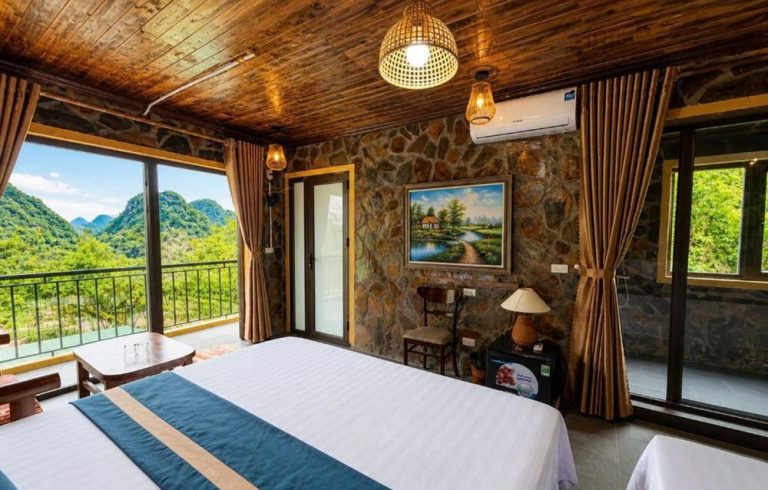
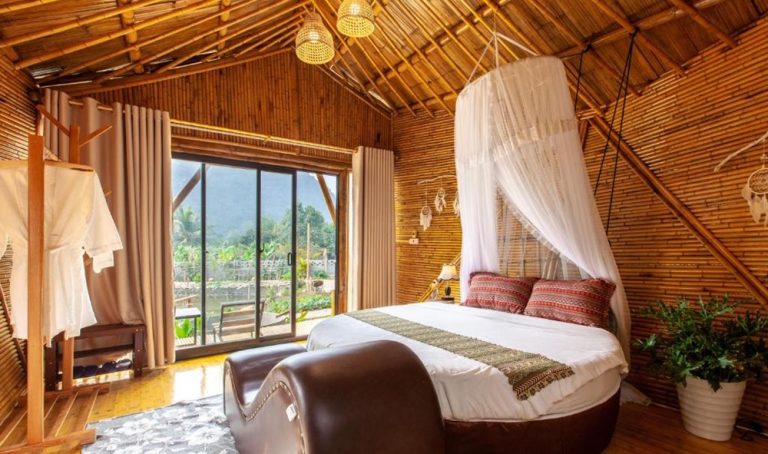
Stay around Trang An if waking up among limestone mountains and quiet countryside matters more to you than having restaurants and nightlife immediately outside your door. Accommodation here tends to feel more rural and spread out than in Tam Coc, with homestays and bungalows tucked beneath the karsts and surrounded by fields, gardens and waterways. You'll be well positioned for the Trang An Landscape Complex and Hoa Lu area, but you'll rely more heavily on a bicycle, scooter, taxi or driver when travelling elsewhere.
Trang An Lamia Bungalow
Thôn Đại Áng, xã Ninh Hòa, huyện Hoa Lư, Ninh Binh, Vietnam — +84 812 666 262
Trang An Lamia Bungalow is well suited to travellers who want a peaceful countryside base surrounded by the landscapes that make the Trang An area special. It offers a very different stay from central Tam Coc or Ninh Binh City and is particularly appealing if tranquillity and natural surroundings are more important to you than being within walking distance of a large choice of restaurants. Check current rates and availability at Trang An Lamia Bungalow.
Browse More Hotels near Trang An
Compare accommodation around Trang An if you want a quieter rural stay among the karsts while remaining close to the boat complex, Hoa Lu and several of Ninh Binh's major historical attractions.
NINH BINH CITY CENTER – BEST FOR TRANSPORT & CONVENIENCE
Ninh Binh City is the most practical base if convenient transport connections and everyday city services matter more than staying directly among the rice fields and karsts. The railway station is here, along with a broader selection of local restaurants, shops and services. The trade-off is atmosphere: you'll need transport to reach most of the natural attractions, and the city itself doesn't provide the same immediate sense of being immersed in the Ninh Binh landscape that you'll find around Tam Coc or Trang An.
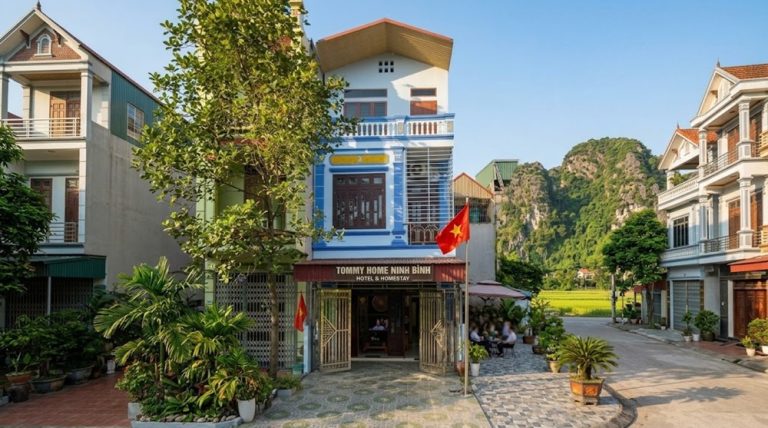
Tommy Home Ninh Bình
21 Bà Triệu, 08000 Ninh Binh, Vietnam
Tommy Home Ninh Bình provides a convenient city base for travellers who want straightforward access to Ninh Binh's transport connections, restaurants and everyday amenities. It's particularly practical if you're arriving or departing by train or prefer staying in the city and using taxis, scooters or organised transport to explore the surrounding attractions. Check current rates and availability at Tommy Home Ninh Bình.
Browse More Hotels in Ninh Binh City Center
Ninh Binh City is worth comparing if you prioritise rail connections, local restaurants and city conveniences and don't mind travelling out to Tam Coc, Trang An and the surrounding countryside for sightseeing.
👉 Browse All Hotels in Ninh Binh
Still not sure whether Tam Coc, Trang An or Ninh Binh City is the right base for your trip? Compare hotels across Ninh Binh to find the location, facilities and price that work best for your stay. Browse all Ninh Binh hotels and check current rates and availability.
How Many Days Do You Need in Ninh Binh?
For most first-time visitors, two days in Ninh Binh is the sweet spot. That's enough time for a major boat journey, Hang Mua, some history and countryside exploration without rushing between attractions.
Three days gives you time to go beyond the highlights to places such as Van Long Nature Reserve, Thung Nham Bird Park or Cuc Phuong National Park. If you're deciding how Ninh Binh fits into a longer trip, our Vietnam itinerary can help you allocate your time across the country.
One Day in Ninh Binh
One day is enough for an excellent introduction, but you need to be selective. A strong first-time combination is Trang An, Hoa Lu Ancient Capital and Hang Mua, giving you waterways, history and panoramic views.
Choose Tam Coc instead of Trang An if rice-field scenery appeals to you more, or combine Bai Dinh and Trang An if temples and Buddhist architecture are a priority.
Don't attempt Trang An and Tam Coc on the same one-day itinerary. Both require substantial time in a rowing boat, leaving too little room for attractions that would add more variety to your day.
Two Days in Ninh Binh
Two days is what we recommend for most first-time visitors. Spend the first exploring Trang An, Hoa Lu and Hang Mua, then use the second for Tam Coc, Bich Dong Pagoda, Thai Vi Temple and cycling through the surrounding countryside.
If two boat trips feel excessive, replace Tam Coc with Thung Nham Bird Park, Bai Dinh Pagoda or Am Tien and Tuyet Tinh Coc depending on whether nature, temples or history interests you most.
Staying overnight also changes the pace of the trip. You no longer need to organise the entire day around returning to Hanoi and can spend the evening in Tam Coc or visit Hoa Lu Old Town after daytime sightseeing.
Three Days in Ninh Binh
With three days in Ninh Binh, use the additional day for somewhere beyond the standard sightseeing circuit. Cuc Phuong National Park is an excellent choice because you can properly explore its forest, trails, caves and conservation projects without sacrificing Ninh Binh's signature attractions.
Alternatively, visit Van Long Nature Reserve for wildlife and quieter scenery or Phat Diem Cathedral for something completely different from Ninh Binh's boat rides and Buddhist sites.
A third day also gives you useful flexibility: visit Thung Nham when birds are returning to the wetlands, spend longer cycling through the countryside or rearrange Hang Mua and your boat trip if the weather is poor.
Do You Need Four Days or Longer in Ninh Binh?
Most first-time visitors don't need four days. If your Vietnam itinerary is limited, that time may be better spent elsewhere in the country.
However, a longer stay makes sense if you're particularly interested in hiking, wildlife, photography, cycling or slow travel. You can visit Trang An and Tam Coc on separate days, dedicate a full day to Cuc Phuong, explore Van Long or Phat Diem and still leave time for the countryside itself.
Four days or longer can also work if you want Ninh Binh to be a relaxing break between Vietnam's larger cities, with a rural homestay or bungalow becoming part of the experience rather than simply somewhere to sleep.
How Long Should You Stay in Ninh Binh?
Stay two days for the essential Ninh Binh experience, three days if you want to explore beyond the headline attractions, and four or more if hiking, wildlife or slow travel are priorities.
If one day is genuinely all you have, go anyway. Ninh Binh is too close to Hanoi and too spectacular to skip simply because you can't stay as long as we'd ideally recommend.

Best Time to Visit Ninh Binh
The best time to visit Ninh Binh depends partly on what you want the landscape to look like. Comfortable sightseeing weather, lush green scenery and Tam Coc's famous golden rice fields don't occur at exactly the same time.
For generally pleasant conditions, March to May and September to November are among the best periods. If seeing Tam Coc's golden rice fields is a priority, however, late May into early June deserves particular attention.
If you're coordinating Ninh Binh with several other regions, our guide to the best time to visit Vietnam explains how conditions vary across the country.
| Period | What to Expect | Best For |
|---|---|---|
| March–April | Warmer spring weather, increasingly lush scenery and generally more comfortable conditions than summer | Sightseeing, cycling, boat trips and hiking |
| May–June | Hotter and more humid, with Tam Coc's rice fields turning from green towards gold as harvest approaches | Rice-field scenery and photography |
| July–August | Hot, humid and wetter, with frequent showers and very lush landscapes | Travellers who don't mind heat and rain |
| September–November | Gradually cooler and more comfortable, although significant rain remains possible, particularly earlier in the period | General sightseeing and outdoor exploration |
| December–February | Cooler temperatures with more overcast, misty or damp days | Cool-weather sightseeing and avoiding summer heat |
👉 On smaller screens, slide the table to the right to view all columns.
March to April: Some of the Best Weather for Sightseeing
March and April are excellent months for exploring Ninh Binh. Temperatures are generally more comfortable than in summer, making this a particularly good period for climbing Hang Mua, cycling, boat trips and exploring places such as Hoa Lu and Bai Dinh.
The countryside also becomes progressively greener through spring, although the appearance of individual rice fields varies according to planting schedules and local conditions.
Late May to Early June: Visit for Tam Coc's Golden Rice Fields
If you want to see boats travelling along the Ngo Dong River between golden rice fields beneath limestone mountains, late May into early June is the period to watch. The rice around Tam Coc typically approaches harvest around this time, turning sections of the valley from green to yellow and gold.
The exact timing varies with planting, weather and harvesting schedules, so a particular date never guarantees golden fields. It's also hotter and more humid than March or April, creating a trade-off between spectacular rice-field scenery and less comfortable sightseeing weather.
WorldlyRoaming Tip: If Tam Coc's golden rice fields are a priority, check recent local reports and images as your trip approaches rather than relying on an exact annual harvest date.
May to August: Hot, Humid and Very Green
Summer is hot, humid and considerably wetter, making outdoor sightseeing more physically demanding. However, the rain also produces some of Ninh Binh's lushest scenery, with intense greenery, dramatic clouds and mist around the limestone mountains.
Persistent rain can make long Trang An or Tam Coc boat trips uncomfortable, while wet steps and poor visibility reduce the appeal of Hang Mua. Keep your itinerary flexible if the forecast is changeable, but don't assume a wet forecast means losing the entire day: heavy showers can arrive and clear relatively quickly.
September to November: Another Excellent Time for Ninh Binh
September to November is another strong period for visiting Ninh Binh as temperatures gradually become more comfortable. September can still be wet, but conditions generally improve towards October and November.
This is particularly good for travellers more interested in sightseeing than timing their visit around the Tam Coc rice harvest, with comfortable conditions for exploring Trang An, Hoa Lu, Hang Mua and the countryside.
December to February: Cooler but Often Greyer
December through February can be a good choice if you dislike heat, particularly for walking, cycling and climbing Hang Mua. However, days can be grey, misty and damp, and low cloud may obscure the limestone mountains and panoramic viewpoints.
Winter also overlaps with Tet, the Vietnamese Lunar New Year. If your visit falls during the holiday, expect increased domestic travel and possible changes to normal transport and business patterns, making advance accommodation and transport bookings more sensible.
When Is Butterfly Season in Cuc Phuong National Park?
If Cuc Phuong National Park is part of your itinerary, April and May can bring its famous butterfly season, when large numbers may gather around forest roads and trails.
As with the rice harvest, timing depends on weather and seasonal conditions. Treat butterfly season as a possibility rather than something guaranteed simply because you're visiting during a particular week.
So, When Is the Best Month to Visit Ninh Binh?
For comfortable sightseeing, March and April are among our first choices. For golden rice-field photography, consider late May into early June and accept hotter, more humid conditions. October and November provide another excellent window for general sightseeing.
Ultimately, choose your dates according to what matters most: comfortable exploration, golden rice fields, lush summer scenery or cooler weather.
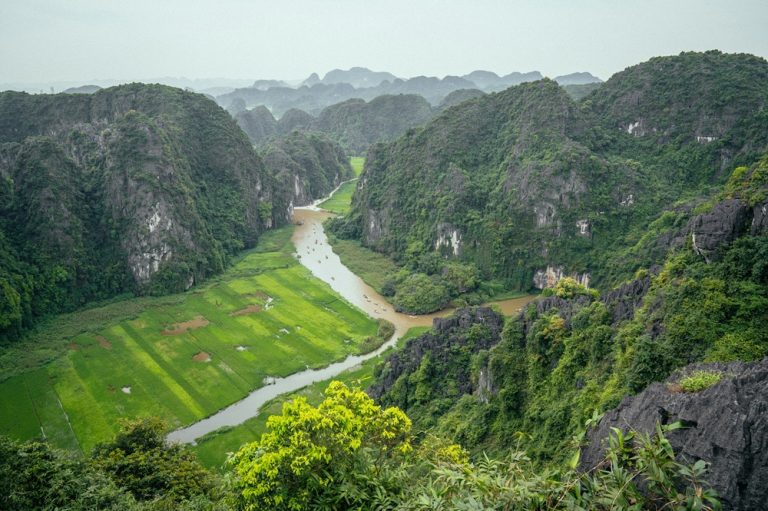
How to Get to Ninh Binh
Ninh Binh is easy to add to a Northern Vietnam itinerary. It lies roughly 90 kilometres south of Hanoi on Vietnam's main north-south transport corridor and can be reached by train, bus, minivan or private transfer.
The important distinction is that Ninh Binh City, Tam Coc and Trang An are different places. Trains arrive in Ninh Binh City, while many travellers stay around Tam Coc or Trang An, so always check where your transport actually terminates and whether you'll need a local transfer.
For a broader overview of transport around the country, see our guide to getting around Vietnam.
How to Get from Hanoi to Ninh Binh
Hanoi is the main gateway to Ninh Binh. The train is straightforward and comfortable, buses and minivans can be more convenient if they drop you near Tam Coc, while a private transfer provides the easiest door-to-door journey.
If you're planning time in the capital first, our Things to Do in Hanoi guide covers its major attractions and experiences.
Hanoi to Ninh Binh by Train
Ninh Binh lies on the Reunification railway line, with several north-south trains stopping there each day. The journey from Hanoi takes a little over two hours on many services and avoids road traffic.
The drawback is that Ninh Binh railway station is in Ninh Binh City. If you're staying around Tam Coc or Trang An, you'll need a taxi or another local transfer after arriving.
Schedules can change, so check current departure times and fares directly with Vietnam Railways before travelling.
Hanoi to Ninh Binh by Bus or Minivan
Buses and tourist minivans generally take around two to three hours, depending on traffic, departure point and stops. They can be more convenient than the train for travellers staying in Tam Coc because some services drop passengers there or close to popular accommodation areas.
Don't book based only on a ticket labelled “Hanoi to Ninh Binh.” Check the exact drop-off location, as a service terminating in Ninh Binh City may still leave you several kilometres from your accommodation.
WorldlyRoaming Tip: Compare the final stop as well as the fare. Paying slightly more for a minivan that drops you in Tam Coc can be more convenient than taking a cheaper service to Ninh Binh City and then paying for another taxi.
Hanoi to Ninh Binh by Private Transfer
A private transfer is the simplest option if convenience matters more than price. It takes you directly from your Hanoi accommodation to Tam Coc, Trang An or a rural Ninh Binh property without changing vehicles or arranging onward transport.
The journey usually takes around two hours in reasonable traffic and becomes particularly practical for couples, families or small groups sharing the cost, travellers with substantial luggage and anyone staying outside the main transport hubs.
How to Get from Hanoi Airport to Ninh Binh
If you're arriving at Noi Bai International Airport, you don't necessarily need to travel into central Hanoi first. Direct private transfers and some shared services travel from the airport to Ninh Binh, avoiding an unnecessary journey into the city before heading south again.
This can be particularly worthwhile after a long international flight. If you're still planning how to enter the country, our guide to travelling to Vietnam covers the main international routes and gateways.
How to Get from Ha Long Bay or Cat Ba to Ninh Binh
Direct tourist buses and minivans connect Ha Long Bay and Cat Ba with Ninh Binh, so there's usually little reason to return to Hanoi first if Ninh Binh is your next stop.
From Cat Ba, the journey includes leaving the island before continuing overland, so allow much of the day rather than planning a major attraction immediately after arrival. As with transport from Hanoi, check whether your service terminates in Ninh Binh City or Tam Coc.
How to Get from Da Nang or Hue to Ninh Binh
If you're travelling north from Da Nang or Hue, Ninh Binh's position on the north-south railway is particularly useful. You can get off at Ninh Binh rather than travelling all the way to Hanoi and then backtracking south.
These are long journeys, so an overnight sleeper train can make practical sense, allowing you to cover much of the distance while sleeping and potentially saving a night's accommodation.
Northbound services from Da Nang and Hue stop at Ninh Binh, but schedules and stopping patterns can change, so check the current Vietnam Railways timetable before building your itinerary around a particular train.
If you're travelling through Central Vietnam first, our Things to Do in Da Nang guide can help you plan that part of your trip.
How to Get from Ho Chi Minh City to Ninh Binh
You can travel from Ho Chi Minh City to Ninh Binh by train, but it's a very long journey. For most travellers with limited time, flying to Hanoi and continuing overland to Ninh Binh is substantially faster.
The train makes more sense if you're deliberately travelling slowly through Vietnam and stopping at destinations along the north-south route. If Ho Chi Minh City is part of your trip, our Things to Do in Ho Chi Minh City guide covers what to see and how to plan your time there.
What Is the Best Way to Get to Ninh Binh?
From Hanoi, take the train for a straightforward independent journey, choose a bus or minivan if it conveniently drops you in Tam Coc, or use a private transfer for the easiest door-to-door option. For a one-day visit, an organised Hanoi day trip is generally more practical than coordinating several independent transfers.
From Central Vietnam, consider travelling directly to Ninh Binh by train rather than going to Hanoi first. Its position on the main railway means Ninh Binh fits naturally between Central Vietnam and Hanoi without unnecessary backtracking.

Getting Around Ninh Binh
Ninh Binh's attractions are spread across the countryside, so the best approach is to use different transport for different parts of your stay. Walk around central Tam Coc, cycle to nearby sights, and use a scooter, taxi or private driver for longer journeys.
| Attraction | Best Transport Options | Why |
|---|---|---|
| Tam Coc | Walking, bicycle | Boat wharf, restaurants and accommodation are concentrated in a compact area. |
| Bich Dong Pagoda | Bicycle, scooter | Close enough to Tam Coc for an enjoyable countryside ride. |
| Thai Vi Temple | Bicycle | The route through the rice fields is part of the experience. |
| Hang Mua | Bicycle, scooter, taxi | Cyclable from Tam Coc, but motorised transport saves energy for the climb. |
| Trang An | Scooter, taxi, private car | Motorised transport is considerably more convenient from Tam Coc. |
| Hoa Lu Ancient Capital | Scooter, taxi, private car | Easy to combine with Trang An or Am Tien. |
| Bai Dinh Pagoda | Scooter, taxi, private car | Far enough from Tam Coc to make motorised transport practical. |
| Thung Nham Bird Park | Scooter, taxi | Accessible from Tam Coc but easier by motorised transport. |
| Van Long Nature Reserve | Scooter, private car | Outside the main Tam Coc sightseeing area. |
| Cuc Phuong National Park | Private car, scooter, tour | A substantial excursion rather than a quick local journey. |
| Phat Diem Cathedral | Private car, scooter | Its location south of Ninh Binh City makes dedicated transport easier. |
👉 On smaller screens, slide the table to the right to view all columns.
Getting Around Ninh Binh by Bicycle
A bicycle is one of the best ways to explore Tam Coc and the surrounding countryside. The terrain is relatively flat, and many hotels and homestays provide bicycles or arrange rentals. Bich Dong Pagoda and Thai Vi Temple are particularly suitable cycling destinations, while Hang Mua is also within range for reasonably active travellers.
For Trang An, Bai Dinh, Van Long, Cuc Phuong and Phat Diem, distances and larger roads make motorised transport more practical. Ninh Binh is excellent for recreational cycling, but a bicycle isn't a universal transport solution.
Getting Around Ninh Binh by Scooter
If you're already comfortable riding in Vietnam, a scooter provides the greatest independence and makes it easy to combine places such as Trang An, Hoa Lu and Am Tien without arranging separate taxis. Rentals are widely available, but check the brakes, tyres, lights and general condition before accepting a bike.
Vietnamese traffic can be unpredictable even on rural roads. If you don't normally ride, don't learn simply because renting a scooter seems convenient; taxis and private drivers are easy alternatives.
Using Grab and Taxis in Ninh Binh
Taxis are useful between Ninh Binh City, Tam Coc and the major attractions, while Grab can help you find available rides without negotiating fares. However, app-based transport may be less readily available in remote areas than in Hanoi or Ho Chi Minh City.
WorldlyRoaming Tip: If you're taking a taxi or private car to a remote attraction, arrange the return journey or a pickup time before your driver leaves. Don't assume another car will be waiting nearby.
Hiring a Private Driver in Ninh Binh
A private car with a driver is particularly practical for couples, families or small groups who don't want to ride scooters. Instead of arranging separate taxis, you can build your own itinerary around places such as Bai Dinh, Van Long, Phat Diem or Cuc Phuong while your driver handles the roads and parking.
Can You Walk Around Ninh Binh?
Central Tam Coc is easily walkable, with accommodation, restaurants, cafés, shops and the boat departure point close together. Ninh Binh's wider attractions are not: many are separated by kilometres of countryside.
What Is the Best Way to Get Around Ninh Binh?
For most travellers, a combination works best: walk around Tam Coc, cycle to Bich Dong, Thai Vi and nearby countryside, then use a scooter, taxi or private driver for more distant attractions. Confident riders gain the most freedom from a scooter; everyone else can comfortably explore using taxis and drivers.

Ninh Binh Travel Costs
Ninh Binh is a relatively affordable destination, particularly if you're travelling independently. Accommodation and sightseeing are usually the biggest expenses, while local food, walking and cycling can keep everyday costs low.
Your budget rises if you take multiple boat trips, visit several paid attractions or rely on taxis, private drivers and organised tours. For costs across your entire trip, see our Vietnam travel budget guide.
| Travel Style | Accommodation | Food & Local Transport | Sightseeing | Approximate Daily Budget |
|---|---|---|---|---|
| Budget | US$10–20 | US$10–15 | US$5–15 | US$25–50 |
| Mid-range | US$25–60 | US$15–30 | US$10–30 | US$50–120 |
| Comfortable | US$60+ | US$25–50+ | US$20–50+ | US$105+ |
👉 On smaller screens, slide the table to the right to view all columns.
These are planning ranges, not fixed daily costs. A day cycling through the countryside may cost very little, while a boat trip, several attractions and a private driver can make another day considerably more expensive. Accommodation prices also vary by property, season and booking date.
Accommodation Costs in Ninh Binh
Budget homestays and guesthouses can cost around US$10–20 per night, while roughly US$25–60 gives you a broad choice of comfortable rooms, bungalows, homestays and small hotels. Higher-end properties around Tam Coc and Trang An often add pools, gardens and limestone-mountain views.
Location can affect your overall budget. Paying slightly more to stay conveniently in Tam Coc may let you walk to restaurants and the boat wharf and cycle to nearby attractions, while an isolated countryside property can mean additional transport costs.
Food Costs in Ninh Binh
Local food is inexpensive, and around US$10–15 per person per day can cover simple Vietnamese meals without deliberately searching for the cheapest options. Tourist-oriented restaurants, Western food, cocktails and imported drinks will increase that considerably.
Ninh Binh's famous mountain goat also generally costs more than a simple noodle or rice dish. Sharing several goat preparations with cơm cháy is a practical way to sample the regional specialties without ordering too much.
Transport Costs in Ninh Binh
Walking and cycling around Tam Coc are the cheapest options, while scooter rental remains economical if you're comfortable riding and want independent transport between several attractions. Fuel costs for typical sightseeing distances are modest.
Taxis become more expensive when used repeatedly for distant attractions, while a private driver costs more but can offer reasonable value for couples, families or groups. You're paying not only for transport but also for the convenience of having a vehicle waiting throughout the day.
How Much Does Sightseeing Cost in Ninh Binh?
Several major experiences involve additional costs, including Trang An and Tam Coc boat trips, Hang Mua, transport within the Bai Dinh complex and several nature attractions. Individual charges are manageable, but they add up if you visit several paid attractions or take both major boat trips.
Plenty of Ninh Binh can also be enjoyed cheaply or for free. Cycling through the countryside, exploring Tam Coc and enjoying the rural landscape can occupy substantial parts of a day without another admission ticket. You don't need to pay for something every hour to experience Ninh Binh properly.
Are Ninh Binh Tours Expensive?
Organised tours cost more than basic independent sightseeing, but the price may include return transport, local transfers, admission fees, a boat journey, a guide and sometimes meals. Recreating the same itinerary independently means paying for several of those components separately.
Independent travel will usually be cheaper during a multi-day stay. For a one-day trip from Hanoi, however, paying more for an organised tour can be worthwhile because the logistics are handled and your limited sightseeing time is used more efficiently.
How Much Should You Budget per Day in Ninh Binh?
A budget traveller using inexpensive accommodation, local food and mostly bicycles or a scooter can aim for around US$25–50 per person per day. A comfortable mid-range trip with better accommodation, restaurant meals, paid attractions and occasional taxis is more likely to cost around US$50–120 per person per day.
Higher-end accommodation, private transport, organised experiences and more expensive restaurants can push spending to US$100 or considerably more per day. None of that is necessary to enjoy Ninh Binh: even a relatively inexpensive trip can include its signature boat journeys, viewpoints, historical sites and countryside.

Practical Ninh Binh Travel Tips
Ninh Binh is easy to explore once you understand how the region works. Attractions are spread across the province, so where you stay, how you get around and how much you schedule each day make a real difference.
Understand Ninh Binh, Tam Coc and Trang An
Tam Coc, Trang An and Ninh Binh City are separate places. For most first-time visitors, Tam Coc is the easiest base, with restaurants, the boat wharf, bicycle rentals and several attractions nearby. Trang An is quieter and more rural, while Ninh Binh City is convenient for the railway station and everyday services. Check the property's actual map location before booking rather than relying on “Ninh Binh” in the address.
Don't Try to Fit Too Much Into One Day
Boat trips take several hours, temple complexes can be extensive and travelling between attractions takes time. Trang An, Hang Mua and Hoa Lu already make a substantial day. Cuc Phuong, Van Long and Phat Diem are more distant and deserve proper time rather than being treated as quick detours.
Choose Your Trang An Boat Route Carefully
Trang An has several boat routes with different caves, temples and stops. Check the available options before boarding if there's something particular you want to see. Routes and access can change with conditions, so don't build your plans around one exact itinerary.
Don't Confuse Boat Tips With Admission Fees
Travellers may choose to tip the rowers at Trang An and Tam Coc, but tips are voluntary and separate from the official ticket price. At Tam Coc, travellers have also reported requests for tips or purchases during some journeys. If you tip, do so because you want to rather than because you think it's another compulsory charge.
Carry Some Vietnamese Dong
Cards are increasingly accepted at hotels and larger businesses, but cash remains useful for small restaurants, shops, bicycle rentals, parking and other local transactions. ATMs are available around Ninh Binh City and Tam Coc, but withdraw enough before spending the day at more remote attractions.
Dress Appropriately at Religious Sites
Bai Dinh, Bich Dong, Thai Vi, Am Tien, Hoa Lu and Phat Diem remain religious sites rather than simply tourist attractions. Cover your shoulders and knees, follow instructions about shoes and restricted areas, and remember that services and worship take priority over sightseeing.
Keep Your Plans Flexible Around the Weather
Weather matters particularly at Hang Mua, where thick cloud can obscure the reason for making the climb: the view. If you're staying several days, rearrange your itinerary when necessary. Light mist can make Trang An and Tam Coc atmospheric, while several hours of heavy rain is a different proposition.
Plan Transport From Remote Attractions
Mobile data is useful for navigation and arranging rides, but Grab availability isn't guaranteed in remote areas. An eSIM for Vietnam can keep you connected without relying on Wi-Fi, but for distant attractions it's still sensible to arrange a return journey with your driver in advance.
Check the Rules Before Flying a Drone
Ninh Binh is spectacular from the air, but open countryside doesn't automatically mean unrestricted drone use. Vietnamese regulations, protected areas and individual attraction rules may apply, including within the UNESCO-listed Trang An landscape. Check current national and local restrictions before flying rather than relying on what you've seen other travellers do.
Only Rent a Scooter if You're Comfortable Riding
Scooters offer excellent freedom, but rural roads still have cars, buses, trucks and unpredictable traffic. If you're already a confident rider and meet the applicable licensing requirements, they're extremely useful. Otherwise, bicycles, taxis and private drivers are perfectly workable alternatives.
For a trip involving hiking, cycling or motorbike travel, our travel insurance guide explains what to check when comparing coverage, including whether your planned activities and circumstances are actually covered.
Leave Time to Explore Without an Attraction
Not every hour needs an attraction attached to it. Cycling beneath the karsts, passing rice fields, stopping beside a waterway or following a quiet village road are part of the Ninh Binh experience too.
This is one of the best reasons to stay at least two days: Ninh Binh becomes more rewarding when you occasionally have time to stop following the itinerary.
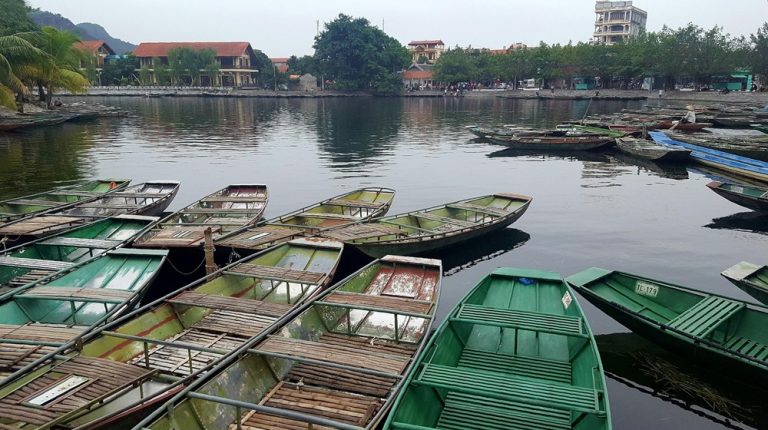
Final Thoughts on the Best Things to Do in Ninh Binh
Ninh Binh may sit only a couple of hours south of Hanoi, but it feels remarkably far removed from the traffic and intensity of Vietnam's capital. Rivers disappear beneath limestone mountains, rice fields stretch between enormous karsts, ancient temples occupy valleys that have been important to Vietnamese history for more than a thousand years, and some of the country's most memorable scenery can be explored from a rowing boat or bicycle.
Trang An, Tam Coc and Hang Mua understandably dominate most lists of the best things to do in Ninh Binh, and all three deserve their reputation. But limiting your visit to those headline attractions misses part of what makes the region special. Bich Dong, Hoa Lu, Bai Dinh, Van Long, Cuc Phuong and the smaller temples and rural roads scattered between them reveal very different sides of Ninh Binh.
For most first-time visitors, we recommend spending at least two days in Ninh Binh. That's enough time to experience the major landscapes without turning the trip into a race between attractions. Stay longer and you can venture farther from the standard sightseeing circuit, spend a day in Cuc Phuong National Park or simply leave space for cycling through the countryside without needing every road to lead somewhere famous.
And that's ultimately one of the reasons Ninh Binh is worth staying overnight rather than treating exclusively as a day trip from Hanoi. Some of the best moments don't necessarily happen at an attraction. They happen between them, when the road narrows between rice fields, another limestone mountain appears around the corner and you have enough time to stop simply because you want to.
Ninh Binh is also only one part of a much larger journey through the country. If you're still deciding where to go, start with our Things to Do in Vietnam guide for an overview of the destinations and experiences worth considering, then use our Vietnam itinerary to work out how Ninh Binh can fit into your route.
Once the route begins taking shape, our Where to Stay in Vietnam guide can help you choose the right bases as you travel through the country.
If you're exploring Northern Vietnam, Ninh Binh combines particularly naturally with the capital, and our Things to Do in Hanoi guide covers everything you need to plan that part of the journey.
Heading farther south, continue through Central Vietnam with our Things to Do in Da Nang guide before exploring the country's largest southern city with our Things to Do in Ho Chi Minh City guide.
Whether Ninh Binh becomes a short stop between Hanoi and Central Vietnam or one of the places where you deliberately slow down, give the landscape enough time to become part of the experience. The boat journeys and viewpoints may bring you here, but the mountains, waterways and countryside between them are what make Ninh Binh difficult to forget.
Explore More of Vietnam
Ninh Binh is only one part of a much bigger Vietnam journey. If you're planning to explore more of the country, continue with these WorldlyRoaming destination guides:
- Things to Do in Hanoi – temples, street food and the energy of Vietnam's capital.
- Things to Do in Da Nang – beaches, city life and a convenient base for exploring central Vietnam.
- Things to Do in Hoi An – Ancient Town, local food and the surrounding countryside.
- Things to Do in Nha Trang – beaches, island hopping, cultural sights and coastal experiences.
- Things to Do in Ho Chi Minh City – history, food and the energy of southern Vietnam.
For the bigger picture, start with our Things to Do in Vietnam guide.
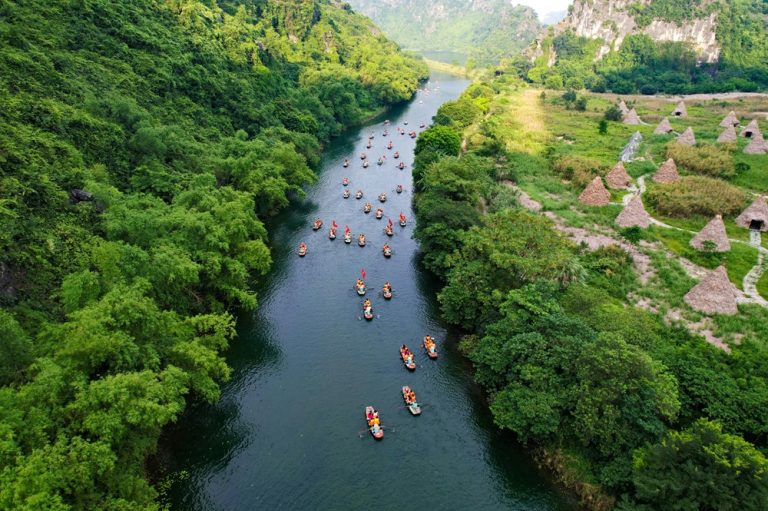
Frequently Asked Questions About Ninh Binh
- Is Ninh Binh worth visiting?
Yes. Ninh Binh is worth visiting for its limestone karst scenery, river landscapes, rice fields, temples and historical sites. Trang An, Tam Coc and Hang Mua are the best-known attractions, but staying longer also gives you access to places such as Van Long Nature Reserve, Cuc Phuong National Park and the quieter countryside around Tam Coc. - What is Ninh Binh famous for?
Ninh Binh is famous for dramatic limestone mountains rising above rivers and rice fields. It is particularly known for the Trang An Landscape Complex, Tam Coc boat rides, Hang Mua viewpoints, Hoa Lu Ancient Capital and Bai Dinh Pagoda. - What are the best things to do in Ninh Binh?
The best things to do in Ninh Binh include taking a Trang An or Tam Coc boat ride, climbing Hang Mua, visiting Hoa Lu Ancient Capital, exploring Bich Dong and Bai Dinh pagodas and cycling through the countryside. Travellers with more time can also visit Thung Nham Bird Park, Van Long Nature Reserve and Cuc Phuong National Park. - How many days do you need in Ninh Binh?
Two days in Ninh Binh is ideal for most first-time visitors. That gives you enough time for a major boat trip, Hang Mua, Hoa Lu and some countryside exploration, while three days allows you to add quieter or more distant attractions such as Van Long or Cuc Phuong. - Is one day enough for Ninh Binh?
One day is enough for a good introduction to Ninh Binh, but you will need to be selective. A strong one-day itinerary might combine Trang An, Hoa Lu Ancient Capital and Hang Mua rather than trying to visit every major attraction. - Can you do Ninh Binh as a day trip from Hanoi?
Yes. Ninh Binh is one of the easiest major day trips from Hanoi and can be reached in roughly two hours depending on traffic and transport. A day trip works well if time is limited, although staying overnight gives you a much less rushed experience. - How far is Ninh Binh from Hanoi?
Ninh Binh is roughly 90 kilometres south of Hanoi. Most road journeys take around two hours, while trains also connect Hanoi with Ninh Binh City. - How do you get from Hanoi to Ninh Binh?
You can travel from Hanoi to Ninh Binh by train, bus, tourist minivan or private transfer. The best choice depends on where you are staying, because trains arrive in Ninh Binh City while some buses and minivans continue closer to Tam Coc. - Is Ninh Binh better than Ha Long Bay?
Ninh Binh and Ha Long Bay offer different experiences. Ninh Binh is better if you want cycling, temples, rice fields, viewpoints and countryside exploration, while Ha Long Bay is centred around cruising between limestone islands on the sea. If your itinerary allows it, they complement each other rather than replacing one another. - Is Trang An or Tam Coc better?
Trang An is the stronger all-round choice for most first-time visitors because its boat routes combine caves, enclosed valleys, waterways and cultural stops. Tam Coc is better if your priority is open river scenery and rice fields, especially when the fields are green or approaching harvest. - Can you do Trang An and Tam Coc in one day?
You can, but we do not recommend it. Both boat trips take a substantial amount of time, and doing both in one day leaves little room for attractions such as Hang Mua, Hoa Lu or Bich Dong. - Is Trang An worth visiting?
Yes. Trang An is one of Ninh Binh's essential experiences, with rowing boats passing through caves, limestone valleys and waterways surrounded by towering karsts. If you only have time for one major boat trip in Ninh Binh, Trang An is our first choice. - Is Tam Coc worth visiting?
Yes. Tam Coc is especially worthwhile for its open river landscape, limestone peaks and rice fields lining the Ngo Dong River. It is also extremely convenient if you are staying in Tam Coc itself because the boat wharf is in the centre of the area. - What is the best time to visit Ninh Binh?
March to May and September to November are among the best periods for visiting Ninh Binh because conditions are generally more comfortable for sightseeing. If you specifically want Tam Coc's golden rice-field scenery, late May into early June can be particularly rewarding. - When are the rice fields green in Ninh Binh?
The appearance of Ninh Binh's rice fields changes throughout the growing cycle, and timing varies according to planting and weather conditions. Spring and early summer can bring vivid green landscapes before the fields begin turning golden as harvest approaches. - When are the rice fields golden in Tam Coc?
The rice fields around Tam Coc often turn golden around late May and early June as harvest approaches. Exact timing changes from year to year, so travellers visiting specifically for the golden fields should check recent local conditions close to their travel dates. - Where should you stay in Ninh Binh?
Tam Coc is the best place to stay for most first-time visitors because it combines restaurants, accommodation, bike rentals and easy access to several major attractions. Trang An is better for travellers who want quieter rural surroundings, while Ninh Binh City is more practical for transport connections. - Is it better to stay in Ninh Binh or Tam Coc?
For most leisure travellers, Tam Coc is a better base than Ninh Binh City. Tam Coc places you closer to the countryside and several major attractions, while Ninh Binh City is more useful if railway access and urban services are your priority. - Can you get around Ninh Binh without a scooter?
Yes. You can walk around Tam Coc, use bicycles for nearby attractions and countryside exploration and rely on taxis or private drivers for longer journeys. A scooter is convenient but not necessary. - Do you need a motorbike in Ninh Binh?
No. A motorbike gives experienced riders more independence, but travellers who do not want to ride can explore Ninh Binh comfortably using bicycles, taxis, private drivers and organised tours. - Is Ninh Binh walkable?
Central Tam Coc is walkable, but Ninh Binh as a wider destination is not. Major attractions are spread across the countryside, so you will need a bicycle or motorised transport for many journeys. - How much does it cost to visit Ninh Binh?
Budget travellers can often manage on around US$25–50 per person per day, while a comfortable mid-range trip may cost around US$50–120 per person per day. Your total depends heavily on accommodation, paid attractions, boat trips, tours and how much you spend on private transport. - Is Ninh Binh expensive to visit?
No. Ninh Binh remains affordable by international standards, particularly if you stay in a homestay, eat local food and explore independently. Costs rise when you add multiple paid attractions, organised tours or private transportation. - What food is Ninh Binh famous for?
Ninh Binh is best known for mountain goat and cơm cháy, or crispy rice. You may also encounter mountain snails and eel noodle dishes alongside the wider range of Northern Vietnamese food available throughout the region. - What should you wear in Ninh Binh?
Wear practical clothing suited to outdoor sightseeing and carry something that allows you to cover your shoulders and knees when visiting religious sites. This is particularly relevant at places such as Bai Dinh, Bich Dong, Thai Vi, Hoa Lu and Am Tien. - Is Ninh Binh suitable for families?
Yes. Ninh Binh can work very well for families because many of its main experiences involve boat rides, countryside scenery and cultural attractions rather than difficult hiking. Hang Mua is the main exception for anyone who may struggle with a steep climb involving hundreds of steps. - Can you visit Ninh Binh in the rain?
Yes, although rain affects different attractions differently. Mist can make the karst landscapes atmospheric, but prolonged heavy rain can make boat trips less comfortable and reduce visibility from Hang Mua, so a multi-day stay gives you more flexibility to rearrange plans. - What is there to do in Ninh Binh at night?
Ninh Binh is much quieter after dark than Hanoi or Ho Chi Minh City. Travellers staying in Tam Coc can enjoy restaurants and a relaxed evening atmosphere, while Hoa Lu Old Town in Ninh Binh City offers illuminated traditional-style architecture, lakeside scenery and evening activities. - Should you stay overnight in Ninh Binh?
Yes, if your itinerary allows it. Staying at least one night gives you considerably more time to explore the countryside and major attractions without working around a same-day return to Hanoi. - Where should you go after Ninh Binh?
Ninh Binh fits naturally between Hanoi and Central Vietnam. You can travel north to Hanoi or continue south by train towards destinations such as Hue and Da Nang, making Ninh Binh an easy stop within a longer Vietnam itinerary.
Travel Resources to Plan, Book & Stay Connected
Use these tools and guides to stay connected abroad, find inspiration for your next trip, and book your flights, stays and gear with confidence.
Disclosure: This article may contain affiliate links. If you make a purchase through a link, I may receive a commission at no extra cost to you. I only share recommendations I believe are genuinely useful, and all opinions are my own. AI was used in this post for research and drafting purposes.

Comment (0)